
How Is Fog Formed?
Are you looking for an easy way to teach your child about weather and climate? We’ve put together a set of free materials that parents and teachers can use right away. In this lesson, your child will dive into the fascinating world of fog.
We’ll explore the formation and measurement of fog near the ground. Explore science in a more engaging way with captivating 3D videos and interactive quizzes. Download our app to get started!
Table of Contents
What You Will Learn From This Lesson
- Water vapor forms fog when air cools.
- Visibility measures how thick the fog is.
- Water vapor forms dew, ice fog, and rime ice.
How Does Fog Form Near the Ground?
Fog is created from water vapor that exists in the air close to the ground. This water vapor is invisible to the eye but transforms when the temperature drops. As the air cools, the water vapor turns into tiny, visible water droplets. When a sufficient number of these small droplets gather and float in the air, they form what we recognize as fog.
How Do We Measure Fog Thickness?
To accurately describe how thick the fog is, meteorologists use a measurement called visibility. Visibility is the greatest distance a person with normal sight can clearly see. The lower the visibility measurement is, the thicker or denser the fog is. For example, if you can only see objects up to 50 meters (about 165 feet) away in the fog, then the visibility is 50 meters (165 feet). Safety precautions are essential on days with heavy fog.
What Else Does Water Vapor Become?
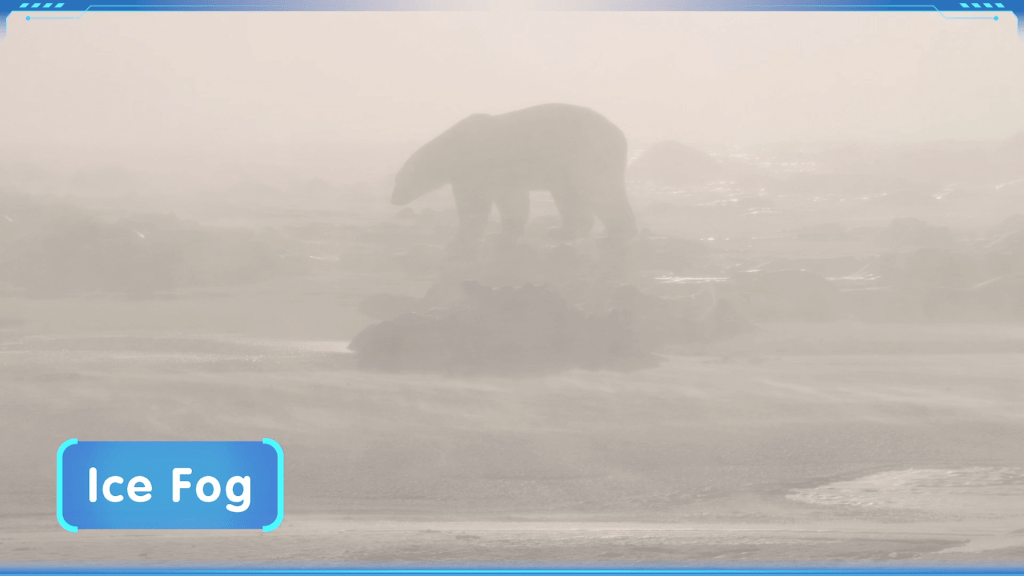
Water vapor is highly versatile and changes its form based on temperature. If the temperature is very low, the vapor floating in the air can change into tiny ice crystals, which creates ice fog. If water vapor attaches as tiny droplets to surfaces that are cool, it becomes dew. It can also transform directly into ice crystals that cling to surfaces, which is known as rime ice.
Fun Fact
- Fog begins as invisible water vapor floating near the ground.
- When the air gets colder, the invisible vapor changes into tiny droplets you can see.
- Water vapor doesn’t just make fog; it can also become the frost you see on surfaces (rime ice).
- If it’s extremely cold, fog can form out of tiny ice crystals instead of water droplets.
- Meteorologists use the farthest distance you can see (visibility) to describe the thickness of the fog.
Vocabulary
- Fog: Formed when enough small water droplets or ice crystals, created from cooling water vapor, gather near the ground and float in the air.
- Water Vapor: Water in the form of an invisible gas that is found in the air.
- Ice Crystals: Tiny pieces of frozen water that can form fog in very cold conditions or attach to surfaces.
- Visibility: The farthest distance a person with normal vision can clearly see, used to measure how thick the fog is.