
What Are Ocean Zones?
Are you looking for an easy way to teach your child about ocean zones? We’ve put together a set of free materials that parents and teachers can use right away. In this lesson, your child will dive into the fascinating world of ocean zones.
We’ll explore the three distinct layers of the sea categorized by the amount of sunlight they receive. Explore science in a more engaging way with captivating 3D videos and interactive quizzes. Download our app to get started!
Table of Contents
What You Will Learn From This Lesson
- Identify the three ocean layers based on the amount of sunlight they receive.
- Describe the unique characteristics of the sunlight, twilight, and midnight zones.
- Understand how animals adapt to different depths, temperatures, and light levels in the ocean.
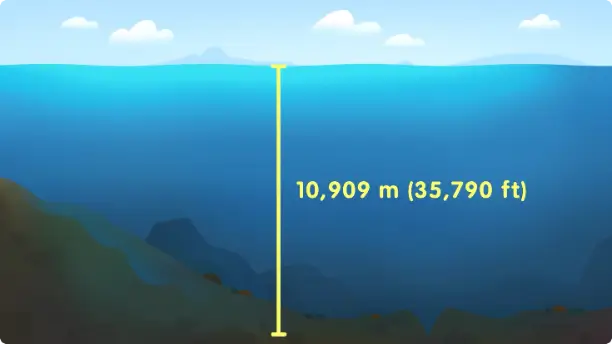
The sea is divided into these three distinct layers based on the amount of sunlight that reaches each level. While certain animals like the sperm whale can dive to 2,000 meters (6,562 feet) to hunt, the deepest part of the ocean reaches 10,909 meters (35,790 feet) —a depth that would completely submerge Mount Everest.
What is the sunlight zone?

The sunlight zone is the top layer of the ocean, extending from the surface down to 200 meters (660 feet). It is characterized by bright light, warmer waters, and an abundance of food, which supports a high density of marine life. This is the only zone where sunlight can shine through clearly, making it a bright and active environment for many animals.
What is the twilight zone?

Reaching depths between 200 and 1,000 meters (660–3,300 feet), the twilight zone receives significantly less light than the surface layer. Because it is much deeper, the water is colder and contains less food, resulting in fewer animals compared to the sunlight zone. Residents here have adapted to the dim conditions, with some species developing exceptionally large eyes to help them see in the dark.
How do animals survive the midnight zone?
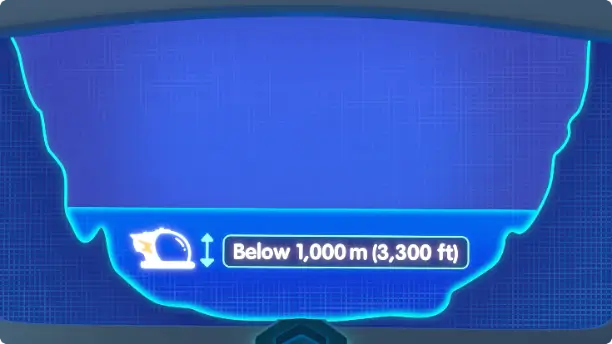
The midnight zone begins at 1,000 meters (3,300 feet) and is characterized by a total absence of sunlight, leaving the environment pitch black. Despite the darkness and the immense depth—which can reach 11,000 meters(36,089 feet)—amazing animals thrive here by producing or reflecting their own light to glow. This layer is the deepest of the three ocean zones categorized by light levels.
Fun Fact
- Even if Mount Everest were placed at the bottom of the deepest trench, its peak would still be over a mile beneath the ocean surface.
- A sperm whale hunting at 2,000 meters (6,562 feet) survives water pressure equivalent to stacking five hundred school buses on top of it.
- The sunlight zone is known as the ocean’s kitchen because it is the only layer where enough light exists to produce food for most marine life.
- Many creatures in the midnight zone survive total darkness by producing their own biological light, acting like living lanterns in the deep sea.
Vocabulary
- Sunlight Zone: The bright, warm top layer of the ocean extending to 200 meters (660 feet) deep, where most marine life lives.
- Twilight Zone: An ocean layer between 200 and 1,000 meters (660–3,300 feet) that receives very little light and is colder than the surface.
- Midnight Zone: The deepest part of the ocean, starting at 1,000 meters (3,300 feet) where there is no sunlight and it is pitch black.