
What Is Seashore Life?
Are you looking for an easy way to teach your child about seashore life? We’ve put together a set of free materials that parents and teachers can use right away.In this lesson, your child will dive into the fascinating world of intertidal life.
We’ll explore the unique biology and survival traits of creatures living along our diverse coastlines. Explore science in a more engaging way with captivating 3D videos and interactive quizzes. Download our app to get started!
Table of Contents
What You Will Learn From This Lesson
- Seashore animals live on beaches, mudflats, and rocky shores.
- Arthropods have segmented bodies, jointed appendages, and undergo molting.
- Echinoderms possess spiny skin, tube feet, and pentaradial symmetry.
What Is Seashore Life?
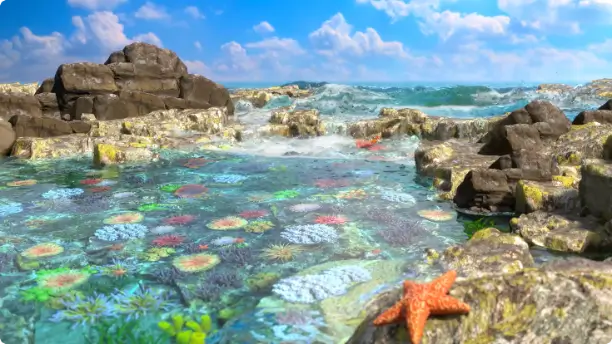
Marine life is not restricted to the open ocean as many fascinating seashore life thrive on sandy beaches, mudflats, and rocky shores. These coastal environments are home to two primary groups of creatures known as arthropods and echinoderms. While they may be experts at hide and seek, careful observation reveals a diverse community of specialized residents.
- Arthropods: This group includes the snapping shrimp, the ghost crab, and the horseshoe crab. These animals are defined by their segmented bodies and jointed appendages, which include their legs and tentacles.
- Echinoderms: This category features the starfish, the brittle star, and the ancient sea lily. Unlike arthropods, these creatures possess bumpy or spiny skin and move using specialized tube feet.
How does seashore life survive and behave?
The sea animals on the seashore use remarkable biological traits to protect themselves and grow in their changing environment. Some coastal inhabitants employ powerful physical defenses, while others rely on unique structural growth patterns to survive.
These behaviors allow them to navigate rocky puddles and sandy terrain effectively. Strategic Defenses and Biological Marvels. While many creatures share this habitat, their survival mechanisms are distinct:
- The Snapping Shrimp: It utilizes a specialized, large pincer to shoot powerful water cannonballs that create exploding air bubbles to deter its enemies.
- The Horseshoe Crab: This unique defense is found alongside the horseshoe crab, which possesses rare blue blood and has protected appendages located underneath its segmented body.
Physical growth presents a unique challenge for armored coastal residents. Because the hard shells of many coastal animals do not expand as they age, arthropods such as ghost crabs and snapping shrimps must shed their old hard shell to accommodate their increasing size. This essential biological process of renewal and physical growth is scientifically known as molting.
Echinoderms display a fascinating approach to both body structure and locomotion:
- Pentaradial Symmetry: Animals such as starfish exhibit this trait, meaning their bodies line up perfectly when rotated around a center point.
- Mechanism of Movement: They navigate the seashore slowly by using countless tiny white tube feet located underneath their bodies.
Fun Fact
- The snapping shrimp slams its oversized pincer so fast that it creates a high-pressure bubble as hot as the surface of the sun to stun its prey.
- When a snapping shrimp’s bubble implodes, it produces a tiny, instantaneous flash of light that is too fast for the human eye to see.
- A starfish can grow back a lost arm, and in some cases, a single severed arm can even grow into an entirely new starfish.
- Instead of walking on its arms like a cartoon character, a starfish moves using hundreds of tiny, water-filled tube feet located on its underside.
- The ghost crab is a master of camouflage that uses long eyestalks to spot predators while its sand-colored body makes it nearly invisible on the beach.
Vocabulary
- Molting: The process where an animal sheds its old shell so it can grow a new and bigger one. Since an exoskeleton cannot grow, the animal must cast it off to allow a larger shell to form.
- Tube Feet: Tiny white tubes found under animals like starfish that are used for walking along the ground. These flexible structures use water pressure to help the animal grip the ocean floor.
- Appendage: A part of an animal’s body that sticks out, such as a leg, a pincer, or a tentacle; these specialized limbs are attached to the main body to help the animal walk, swim, or capture prey.