
What Is a Whale Fall?
Are you looking for an easy way to teach your child about whale fall? We’ve put together a set of free materials that parents and teachers can use right away. In this lesson, your child will dive into the fascinating world of deep-sea ecology.
We’ll explore the four life-giving stages of a sunken whale on the ocean floor. Explore science in a more engaging way with captivating 3D videos and interactive quizzes. Download our app to get started!
Table of Contents
What You Will Learn From This Lesson
- Understand how the massive size of a whale allows it to reach the deep seafloor to create a habitat.
- Identify the four biological stages of a whale fall and the specific animals that visit during each stage.
What is the whale fall?
The whale fall occurs when a large whale dies and its body sinks all the way to the bottom of the sea. While smaller fish or whales are usually eaten before they can reach the deep ocean floor, the massive size of a blue whale allows it to create this unique environment. This process creates a specialized habitat that can sustain hundreds of different marine animal species for about a century.

What are the stages of the whale fall?
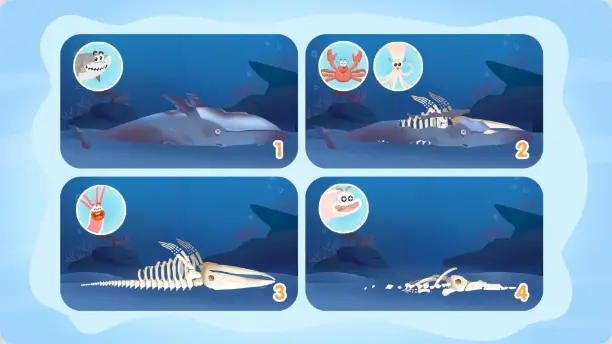
There are four distinct stages of a whale fall that support different types of animals over time.
- In the first stage, fast swimmers like six-gill sharks arrive to eat most of the flesh.
- The second stage involves smaller animals such as octopuses that feed and reproduce until the meat is gone.
- During the third stage, bacteria consume the fat left inside the bones, which then provides food for other creatures like fluffy boneworms.
How does a whale fall support life in the final stage?
In the final stage of a whale fall, the remaining skeleton acts much like a reef. The hard bones create a permanent habitat where many deep-sea animals can live. In fact, a whale fall can sustain more than 400 marine animal species for about a century.
Fun Fact
- The heart of a Blue Whale is the size of a bumper car, and its heartbeat can be heard from two miles away.
- A hungry Blue Whale can swallow 500,000 calories in a single mouthful of tiny, shrimp-like krill.
Vocabulary
- Whale Fall: A unique deep-sea environment created when a large whale dies and sinks to the ocean floor, providing a massive source of food for specialized creatures for many decades.
- Sixgill Shark: A fast-swimming predator with ancient features that typically feeds on the soft tissue during the first stage of a whale fall’s decomposition.
- Boneworm: A small, specialized creature that uses root-like structures to feed on the proteins and fats found deep within whale bones during the final stages of a whale fall.