
What Do Rare Plants Look Like?
Are you looking for an easy way to teach your child about unique and rare plants? We’ve put together a set of free materials that parents and teachers can use right away. In this lesson, your child will dive into the fascinating world of botany.
We’ll explore the unusual shapes of plants and the clever ways they evolve to survive. Explore science in a more engaging way with captivating 3D videos and interactive quizzes. Download our app to get started!
Table of Contents
What You Will Learn From This Lesson
- Rare plants mimic animals or objects to survive.
- Plants evolve specific traits to adapt to environments.
Why do some plants look like animals?
The plant kingdom is full of surprises, and many rare plants have developed forms that look like animals. These unique shapes are often not just for show; they can help the plant interact with its environment or survive.
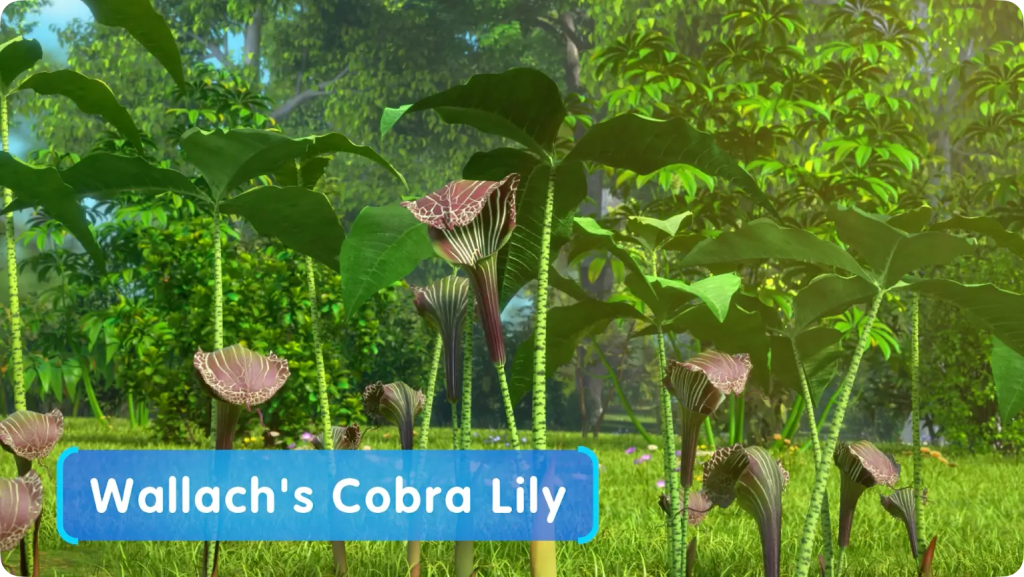
For example, the Wallach’s cobra lily looks just like a cobra standing tall, which can be quite surprising to see in the wild.
Other plants mimic animals in even more specific ways:
- Flying Duck Orchid: This flower looks exactly like a duck that is about to take flight.
- “Hot Lips”: Some plants have bright red petals that are nicknamed “Hot Lips” because of their striking resemblance to a pair of red lips.
- Dove Tree: This is a very rare tree that has been around for millions of years and has flowers that look like white doves resting on its branches.
How do plants use their looks for survival?
Plants evolve specific traits to better adapt to their environments and increase their chances of survival. These “survival skills” help them deal with predators or find ways to reproduce.
For instance, the sheep-eating plant (a type of Puya) has pointy spikes on its leaves to protect its central part from being eaten by animals.
The plant named Fritillaria delavayi grows among grey rocks. While its flowers are usually yellow-green, the ones that are grey-colored are much harder for animals to spot. Because they aren’t eaten as often, the grey-colored plants have a better chance of surviving.

Some plants use camouflage to stay safe:
- Self-Defense: Many plants grow thorns or spikes as a way to protect themselves from being eaten.
- Pollination: Some plants form close relationships with insects, evolving specific shapes that help the insects find them and assist with pollination.
By evolving these helpful traits, rare plants ensure that they can continue to live and grow in their amazing world.
Fun Fact
- The Wallach’s cobra lily is so convincing it might make you jump if you aren’t expecting it!
- Some rare trees, like the dove tree, have been growing on Earth for millions of years.
- “Hot Lips” plants use their bright red color to stand out in the green forest.
- Fritillaria delavayi is a master of disguise, changing color to match the rocks around it.
- Pointy spikes are a plant’s way of telling animals that they are definitely not on the menu.
Vocabulary
- Mimicry: The biological phenomenon where a plant evolves to physically resemble another object or organism, such as an animal, to gain a survival advantage.
- Evolution: The slow and steady process by which plants develop specific traits and shapes over many generations to better adapt to their surroundings.
- Camouflage: A survival strategy where a plant, like the grey-colored Fritillaria delavayi, blends in with its environment to hide from predators.
- Predators: Animals or insects that might eat or damage a plant; many rare plants grow thorns or spikes to protect themselves from these threats.
- Pollination: The process of moving pollen to create new life; some rare plants evolve specific shapes to make it easier for their insect partners to find them.
- Pointy Spikes: Sharp, needle-like structures found on plants like the sheep-eating plant that act as a defensive shield for the plant’s core.
- Dove Tree: A rare “living fossil” tree with white flowers that look like birds, showcasing a form of mimicry that has existed for millions of years.
- Orchid Mimicry: A specific type of evolution seen in flowers like the Flying Duck Orchid, which takes on a very detailed shape to interact with the world around it.