
What Are Prehistoric Marine Reptiles?
Are you looking for an easy way to teach your child about dinosaurs? We’ve put together a set of free materials that parents and teachers can use right away. In this lesson, your child will dive into the fascinating world of prehistoric marine reptiles.
We’ll explore the adaptations of the Plesiosaurus and the Mosasaurus. Explore science in a more engaging way with captivating 3D videos and interactive quizzes. Download our app to get started!
Table of Contents
What You Will Learn From This Lesson
- Prehistoric marine reptiles were distinct from dinosaurs.
- The Plesiosaurus’s long neck helped it hunt fish, squid, and mollusks.
- The Mosasaurus was an apex predator that grew over 40 feet long.
Marine reptiles, such as the Plesiosaurus and Mosasaurus, were not dinosaurs. Instead, they were a distinct type of reptile that lived in the sea during the time of the dinosaurs. These animals were highly adapted for an aquatic lifestyle, featuring specialized body structures that allowed them to swim effectively and hunt successfully.
How Was the Plesiosaurus Adapted for the Sea?
The Plesiosaurus was a marine reptile characterized by a small head and an exceptionally long neck, which could contain over 70 cervical vertebrae. This long neck was a key adaptation; it allowed the Plesiosaurus to silently blend into schools of fish before striking. It also used its head and long neck to shift through the sand on the ocean floor, searching for its prey of fish, squid, and mollusks.
Its limbs were not like those of land animals but were flattened into broad, paddle-like flippers. The leg bones were short and connected to unbranched fingers, forming these powerful, paddle-like flippers that made it an efficient swimmer.
Why Was the Mosasaurus the King of the Ocean?
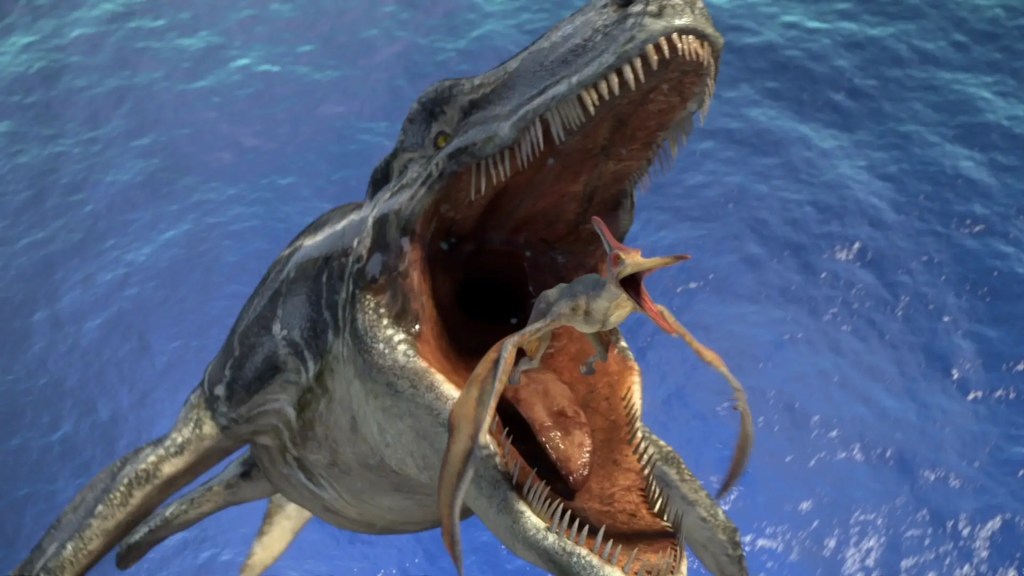
The Mosasaurus was a formidable marine reptile and the ocean’s king during the Cretaceous period. It was an apex predator that grew to be a giant, reaching over 40 feet long and weighing over 20 tons. Its huge size meant it had to live in deep waters, as it could easily get stranded in shallow areas.
The Mosasaurus was adapted for hunting with a powerful combination of physical features. Its body was streamlined to reduce water resistance, and it possessed a flat tail and broad, fin-like flippers, which were ideal for paddling and swift movement.
Although it could swim very fast in short bursts, it often had to hide and wait for the perfect moment to strike, as it couldn’t maintain high speeds for long. The Mosasaurus was a fierce carnivore that preyed on large animals like sharks and other reptiles, including the Plesiosaurus.
Fun Fact
- The Mosasaurus was a giant reptile, up to 43 feet long, making it nearly the size of a school bus.
- A Mosasaurus was such a huge predator that it would get stranded if it swam into shallow waters.
- The Plesiosaurus had over 70 bones in its neck, far more than most modern animals.
- The Plesiosaurus caught its prey by using its neck to disguise its head among a school of fish.
- A Plesiosaurus would eat small stones, called gastroliths, to help it balance better when swimming underwater.
Vocabulary
- Plesiosaurus: A marine reptile with a small head and a very long neck that used broad, paddle-like flippers for swimming.
- Mosasaurus: A massive marine reptile and top predator of the oceans during the Cretaceous period, known for its flat tail, fin-like limbs, and streamlined body.
- Streamlined: A body shape designed to move through water with minimal resistance, which helped the Mosasaurus swim efficiently.
- Marine Reptile: A type of reptile that lived in the sea and was not classified as a dinosaur.