
How Do Muscles Work?
Are you looking for an easy way to teach your child about the human body? We’ve put together a set of free materials that parents and teachers can use right away. In this lesson, your child will dive into the fascinating world of how muscles work.
We’ll explore the role of muscles in human movement. Explore science in a more engaging way with captivating 3D videos and interactive quizzes. Download our app to get started!
Table of Contents
What You Will Learn from This Lesson
- Bones, joints, and muscles work together so a person can move.
- Muscles are important for movement and activity.
How Can Humans Move?
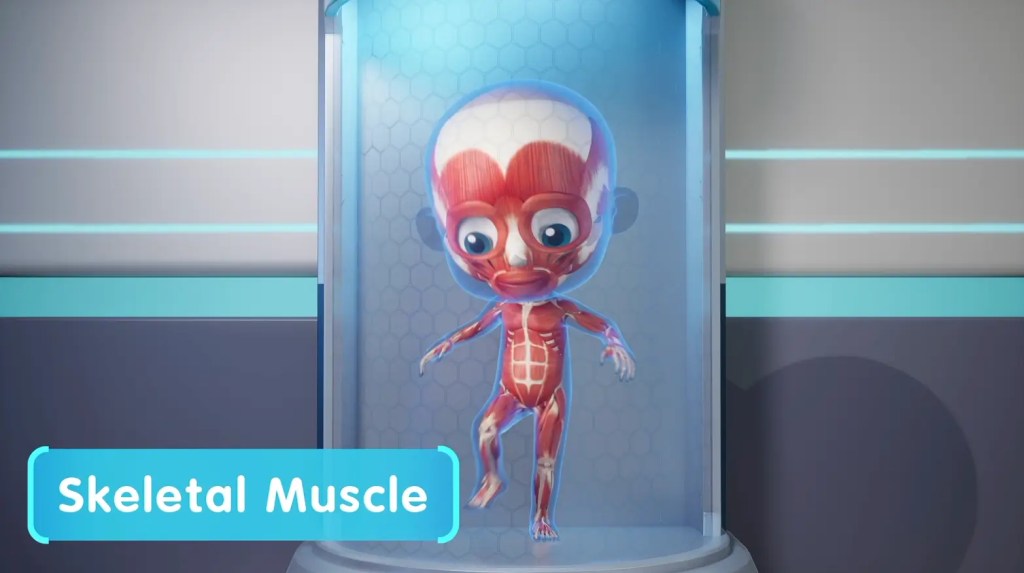
Muscles are essential for movement, wrapping around the bones. The muscles that move the bones are called skeletal muscles. They move the bones by contracting and relaxing. Skeletal muscles are flexible, which allows the body to move for actions such as jumping, throwing, or making facial expressions.
The bones need the help of both joints and muscles to move. Joints allow bones to bend. Meanwhile, muscles contract and relax to pull our bones, which allows us to move. All body movements are produced by muscles. When an arm is bent, the muscles bunch up; they smooth out when the arm is stretched.
What Are the Types of Muscles?
There are three main types of muscle in the human body: skeletal muscle, cardiac muscle, and smooth muscle. Cardiac muscles grow in the heart and contract and relax to keep the heart beating. Smooth muscles grow on organs and allow those organs to contract.
It is important to understand the difference in control between these muscle types. Skeletal muscles are under our direct control, allowing for intentional movements. Conversely, cardiac and smooth muscles move to their own rhythms and are not under our conscious control. Exercising regularly is important to help both bones and muscles become stronger.
Fun Fact
- Making a face, like smiling or frowning, is a movement produced by muscles.
- Your heart has its own unique muscle type that keeps it beating without your thinking about it.
- Muscles wrap around your bones, letting them pull your skeleton into motion.
Vocabulary
- Muscle: Muscles are essential for movement, wrapping around the bones. All body movements are produced by muscles.
- Skeletal muscle: These muscles move the bones by stretching and contracting. Skeletal muscles are flexible, allowing for intentional movements like jumping or making facial expressions.
- Contract: Muscles contract to pull our bones, allowing us to move. When an arm is bent, the muscles bunch up.
- Relax: When a muscle relaxes, it stops pulling and returns to its original shape.
- Cardiac muscle: Cardiac muscles grow in the heart and contract and relax to keep the heart beating. These muscles are not under our conscious control.
- Smooth muscle: Smooth muscles grow on organs and allow those organs to contract. These muscles move to their own rhythms and are not under our direct control.
- Joints: Joints allow bones to bend. They are needed for bones to move.