
How Does the Brain Work?
Are you looking for an easy way to teach your child about the human body? We’ve put together a set of free materials that parents and teachers can use right away. In this lesson, your child will dive into the fascinating world of how the brain works.
We’ll explore the brain’s structure and the five-step process of nerve signal transmission. Explore science in a more engaging way with captivating 3D videos and interactive quizzes. Download our app to get started!
Table of Contents
What You Will Learn From This Lesson
- The brain is made up of the cerebrum, cerebellum, and brainstem.
- Nerve signals are transmitted in a process of five steps.
What Are the Brain’s Parts and Their Functions?

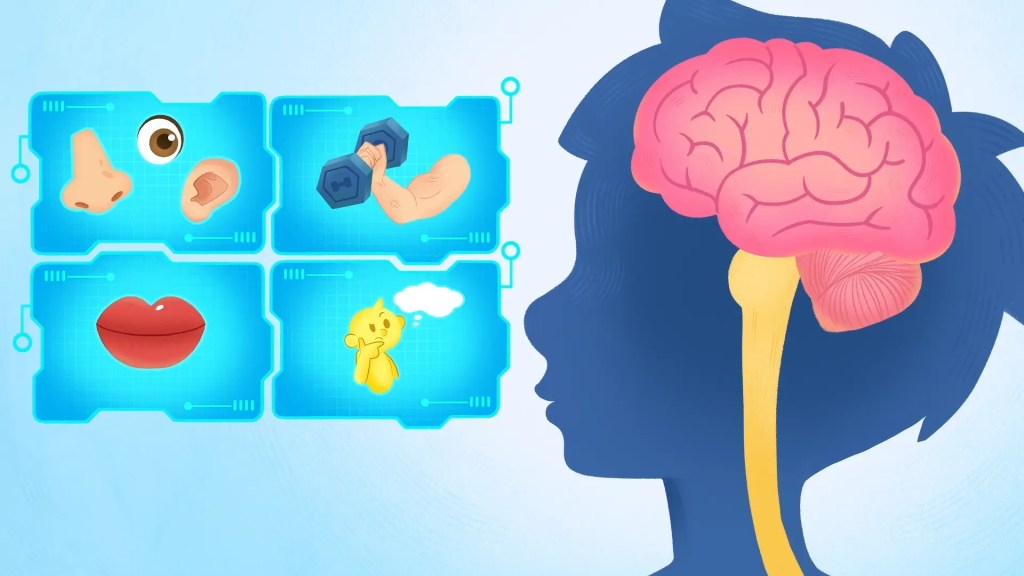
The brain is a super powerful command center that controls the entire body. It is a delicate organ that must be protected, and it is made up of three main parts: the cerebrum, the cerebellum, and the brainstem.
The cerebrum is responsible for many complex tasks. It is where you perceive sensations like sound and smell, control movement, process language, and do all your thinking. It has a wrinkly appearance, like a walnut. Each groove is called a sulcus, and each bump is called a gyrus. The sulci and gyri greatly increase the cerebrum’s surface area. A larger surface area allows the cerebrum to house more neurons, which are the specialized cells that complete tasks, meaning the brain can handle more tasks.
The cerebellum looks different from the cerebrum. Its special job is to help the body maintain balance. Hurting the cerebellum can cause a loss of balance, leading to dizziness.
The brainstem is a critical part of the brain. It controls essential life functions, specifically your heartbeat and breathing. A serious injury to the brainstem could cause both your heartbeat and breathing to stop.
How Does the Brain Send and Receive Signals?
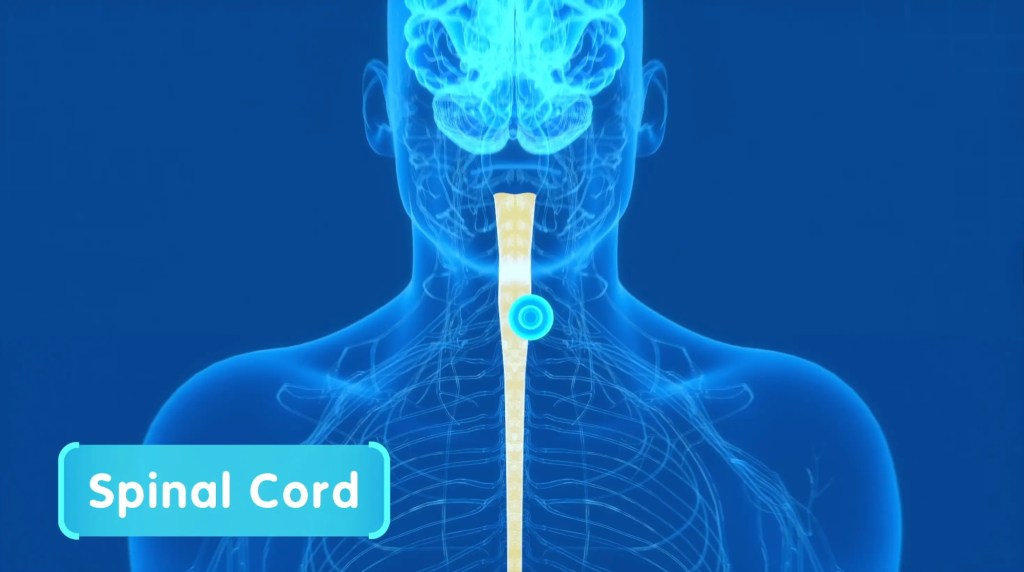
The brain relies on the nervous system to send and receive signals. When the nerves are damaged, the brain cannot send or receive signals and thus cannot control the body. Nerve signals are transmitted in a five-step process.
A signal is generated in the body, such as a cold sensation at the fingertip. The signal is then carried through the nerves to the cerebrum. Signals from the body often travel through the spinal cord, which acts like a highway leading to the brain, but signals generated in the head and neck can reach the cerebrum directly.
The cerebrum processes the signal and sends out an instruction signal. The instruction signal travels through the nerves to reach the correct body part.
Finally, that body part moves accordingly.
Fun Fact
- Your brain is the body’s “command center,” controlling your thoughts, breathing, and feelings.
- The cerebrum, the brain’s largest part, looks wrinkly like a walnut.
- The folds and bumps on your cerebrum increase its surface area to house more neurons.
- The brainstem is vital because it constantly regulates your heartbeat and breathing.
- The cerebellum, which looks different, is crucial for helping your body keep its balance.
Vocabulary
- Brain: The command center that controls the body.
- Cerebrum: The largest part of the brain, responsible for thinking, language, movement, and perceiving sensations.
- Cerebellum: The part of the brain that helps the body to balance.
- Brainstem: The part of the brain that controls essential functions like heartbeat and breathing.
- Sulcus (plural: Sulci): Each groove on the surface of the cerebrum.
- Gyrus (plural: Gyri): Each bump on the surface of the cerebrum.
- Neurons: Specialized cells housed in the cerebrum that are responsible for completing tasks.
- Spinal Cord: A structure like a highway that messages to and from the brain pass through.