
What Are the Different Types of Teeth?
Are you looking for an easy way to teach your child about the human body? We’ve put together a set of free materials that parents and teachers can use right away. In this lesson, your child will dive into the fascinating world of the different types of teeth.
We’ll explore the roles of incisors, canines, premolars, and molars in chewing food. Explore science in a more engaging way with captivating 3D videos and interactive quizzes. Download our app to get started!
Table of Contents
What You Will Learn From This Lesson
- Teeth have two main parts: the crown and the root.
- The four types of human teeth are incisors, canines, premolars, and molars.
- Bacteria and acid can damage the enamel.
What Are the Main Parts of a Tooth?

Our teeth are incredibly important. Tooth enamel is actually the hardest substance in the human body. The primary job of the teeth is to chew and break down food.
A tooth has two main parts: the crown and the root. The crown is the portion you can see above the gum line. The rootis the part that extends below the gum and anchors the tooth in place. The crown is protected by a layer called enamel, which is the hard, outermost layer. If we do not brush them properly, bacteria can create acid that breaks down this enamel, leading to cavities. Humans have two sets of natural teeth in their lifetime: primary teeth and permanent teeth.
How Do Different Teeth Chew Food?
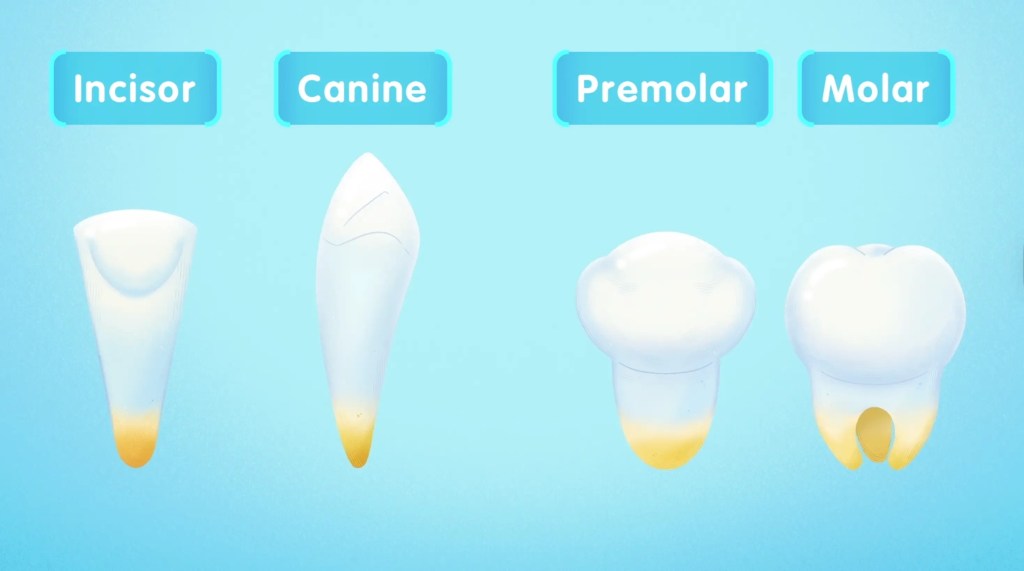
Adults typically have 28 to 32 permanent teeth, which are categorized into four different types. Each type of tooth has a distinct shape and function to help us process food. Together, they work to cut, grip, tear, and grind what we eat.
The four types of permanent teeth are:
- Incisors: These eight teeth have sharp edges and are located at the front of the mouth. Their function is to quickly cut and slice food.
- Canines: We have four canines, which sit on either side of the incisors. They have the longest roots among all the teeth, making them very strong for gripping and tearing food apart.
- Premolars and Molars: These teeth are located deeper inside the oral cavity. They have a wide cross-section and are responsible for grinding food into tiny pieces before swallowing. Adults usually have eight premolars and eight to twelve molars.
Why Do We Get Cavities?

The enamel on our teeth can get damaged. If we do not brush our teeth properly, bacteria in the oral cavity can break down tiny bits of food left on our teeth. This process produces acid.
This acid erodes the hard enamel layer. This damage leads to the creation of cavities. We can protect our teeth and keep the enamel safe by brushing them really well.
Fun Fact
- Tooth enamel is actually the hardest substance in the human body.
- The sharp incisor teeth are your built-in tools for cutting and slicing food.
- Canine teeth have the longest roots, making them extra strong for tearing food.
- Children lose 20 baby (primary) teeth before their 28–32 adult (permanent) teeth arrive.
- Tiny bacteria make acid from food leftovers that can damage the hard, protective enamel layer.
Vocabulary
- Incisors: These are the eight front teeth with sharp edges used for cutting and slicing food.
- Canines: These are the four sharp teeth that help you grip and tear food apart.
- Premolars and Molars: These are the wide, back teeth that are responsible for grinding food into tiny, easy-to-swallow pieces.
- Crown: The part of the tooth that you can see above the gum line.
- Root: The part of the tooth that is hidden below the gum line.
- Enamel: The hard, protective outermost layer of the crown.
- Cavities: Holes in the tooth that happen when bacteria’s acid damages the enamel.