
What Are the Parts of the Ear?

Are you looking for an easy way to teach your child about the human body? We’ve put together a set of free materials that parents and teachers can use right away. In this lesson, your child will dive into the fascinating world of the ear.
We’ll explore the essential parts of the ear and how they work together to enable hearing. Explore science in a more engaging way with captivating 3D videos and interactive quizzes. Download our app to get started!
Table of Contents
What You Will Learn From This Lesson
- The auricle, eardrum, and cochlea are all parts of the ear.
- Sound waves are collected, vibrate the eardrum, and become nerve signals for the brain.
- We should avoid listening to very loud sounds for too long to protect our hearing.
How Do Our Ears Catch and Boost Sound?

When we hear music or a friend’s voice, the sound first enters the outer part of the ear, which is called the auricle. The auricle’s job is to collect the sound. The sound then travels down a tunnel called the ear canal. Inside the ear canal, there is earwax. Earwax is helpful because it can trap dust and stop foreign objects from entering the ear.
The sound waves keep traveling until they reach the eardrum. The sound causes the eardrum to vibrate like a drum. This vibration is then passed on to the ossicles in the middle ear. The ossicles are three small bones that work together to make the vibrations much stronger, or amplify the sound.
What Happens When Sound Waves Reach Our Brain?
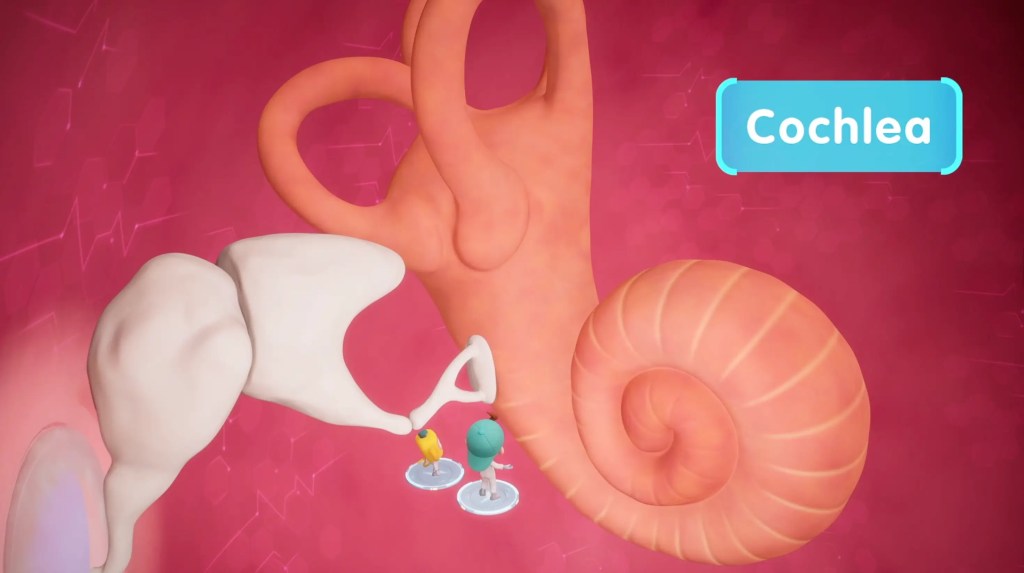
The amplified sound vibrations are received by the cochlea. The cochlea is in the inner ear and looks like a snail shell. It is filled with liquid that contains special hair cells. These hair cells can sense and respond to the vibrations. This response creates nerve signals that are sent to the brain. The brain is what tells us what we are hearing.
How Can We Keep Our Hearing Healthy?

It takes many steps for us to hear. The sound must come in through the auricle, go through the ear canal, hit the eardrum, get amplified by the ossicles, and finally be converted by the cochlea into signals for the brain.
Because so many parts work together, it is important to protect our sense of hearing. We must avoid listening to really loud sounds for too long. If sounds are too loud for too long, they could hurt the hair cells inside the cochlea. Fewer auditory cells mean that a person will have poorer hearing.
Fun Fact
- The outer part of your ear, called the auricle, collects sound like a funnel.
- Earwax is helpful; it traps dust and stops foreign objects from entering the ear.
- The eardrum vibrates from sound, and tiny bones amplify this vibration like a microphone.
- The cochlea is shaped like a snail shell and changes sound vibrations into brain signals.
- Damaged hair cells in your inner ear cannot grow back, so protect your hearing from loud noise.
Vocabulary
- Auricle: The visible, outer part of the ear that collects sound waves.
- Ear Canal: The tunnel that sound waves travel through after being collected by the auricle.
- Eardrum: A part in the ear that vibrates when sound hits it, starting the hearing process.
- Ossicles: The small bones in the middle ear that receive vibrations from the eardrum and make the sound louder.
- Cochlea: The snail-shell-shaped part of the inner ear that changes the vibrations into nerve signals for the brain.
- Hair Cells: Tiny cells found inside the cochlea that sense and respond to vibrations.