
What Are Aquatic Insects?
Are you looking for an easy way to teach your child about aquatic insects? We’ve put together a set of free materials that parents and teachers can use right away. In this lesson, your child will dive into the fascinating world of freshwater ecology.
We’ll explore how specialized body structures allow insects to survive on or under water. Explore science in a more engaging way with captivating 3D videos and interactive quizzes. Download our app to get started!
Table of Contents
What You Will Learn From This Lesson
- Insects use playing dead or bubbles as passive defenses.
- Beetles and bees use chemicals or stingers to fight.
What are aquatic insects?
Insects that spend their entire life cycle in the water are known as aquatic insects. These creatures have evolved unique physical structures to navigate their wet environments.
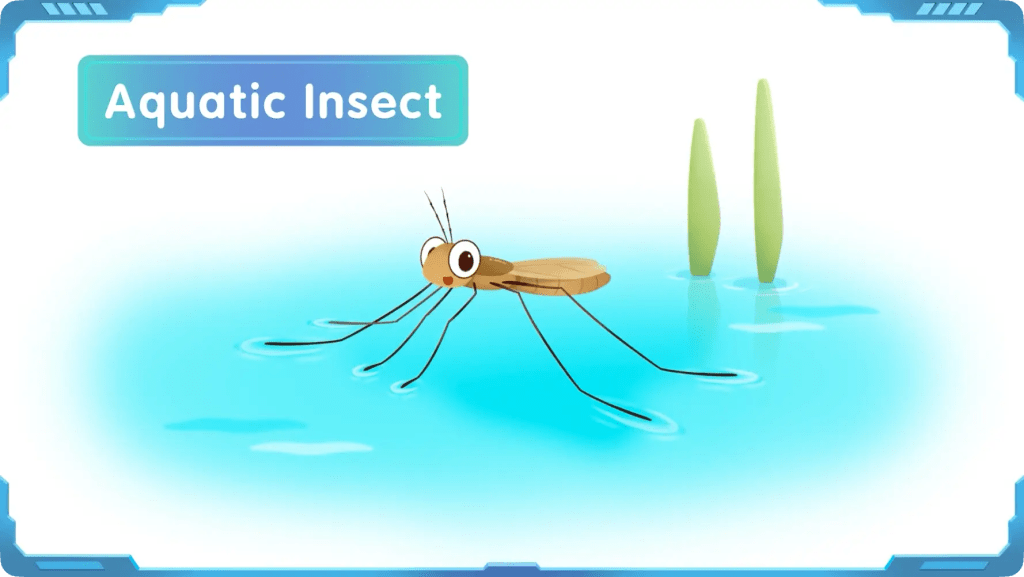
The water strider is a perfect example of this adaptation because it can actually walk on the water surface. Its long and thin legs are covered in tiny bristles that increase surface tension and allow its light body to float like a feather.
Other aquatic insects are experts at diving and swimming beneath the surface. The diving beetle carries its own air supply by trapping a bubble of oxygen at the end of its abdomen before it dives. This bubble acts like a scuba tank and allows the beetle to breathe while it hunts underwater. When the air runs out, the beetle simply swims back to the surface to collect a fresh bubble.
How do insects live both in water and on land?
Some species are classified as semiaquatic insects because they only live in the water during their younger stages. Mosquito larvae, often called wrigglers, must live in water to develop before they become flying adults.
Dragonfly nymphs also grow underwater and possess a specialized mask that they shoot out at lightning speed to capture prey. These nymphs utilize rectal gills to breathe freely in their aquatic habitat just like a fish.
The presence of certain semiaquatic insects can also tell us a lot about the health of a local environment. Stonefly larvae are extremely sensitive to water quality and prefer habitats that are clean and rich in oxygen.
Because they cannot survive in polluted areas, scientists often use them to determine if a stream or pond is healthy. Protecting these water resources is essential for the survival of the diverse family of aquatic insects.
Fun Fact
- A Water Strider has oily hair on its feet that lets it walk on top of the water without ever getting wet.
- Long, thin legs spread the Water Strider’s weight out so it can glide across a pond like a professional ice skater.
- A thirsty Diving Beetle pokes its bottom out of the water to grab a fresh “oxygen tank” of air before diving back down.
- A Dragonfly Nymph has a spring-loaded jaw that shoots out like a harpoon to grab tadpoles and small fish.
Vocabulary
- Aquatic Insects: Species that spend their entire life cycle in the water and have evolved unique physical structures to navigate wet environments.
- Water Strider: An insect capable of walking on the water surface using long, thin legs covered in tiny bristles that increase surface tension.
- Semiaquatic Insects: Insects that live in the water only during their younger stages, such as larvae or nymphs, before maturing into land-based adults.
- Dragonfly Nymphs: The young stage of a dragonfly that grows underwater, using rectal gills to breathe and a specialized “mask” to capture prey.
- Rectal Gills: Specialized respiratory organs used by dragonfly nymphs to extract oxygen from the water, functioning similarly to the gills of a fish.
- Surface Tension: The physical property of the water’s surface that, when increased by an insect’s specialized bristles, allows light-bodied insects to float or walk on water.