
What Are Singing Insects?
Are you looking for an easy way to teach your child about singing insects? We’ve put together a set of free materials that parents and teachers can use right away. In this lesson, your child will dive into the fascinating world of bioacoustics.
We’ll explore how different insects use their bodies to create unique musical sounds. Explore science in a more engaging way with captivating 3D videos and interactive quizzes. Download our app to get started!
Table of Contents
What You Will Learn From This Lesson
- Cicadas and crickets use friction to create musical songs.
- Wing speed and air vibration produce buzzing and hissing.
How do insects produce sounds?
In the natural world, many singing insects create noise by shaking their bodies or rubbing specific parts together to create friction. Cicadas are among the most famous examples of this group.
They possess a specialized sound-producing organ on their abdomen called a tymbal. When a male cicada vibrates this organ, an empty air-filled area inside his body acts like a drum to make the sound much louder.
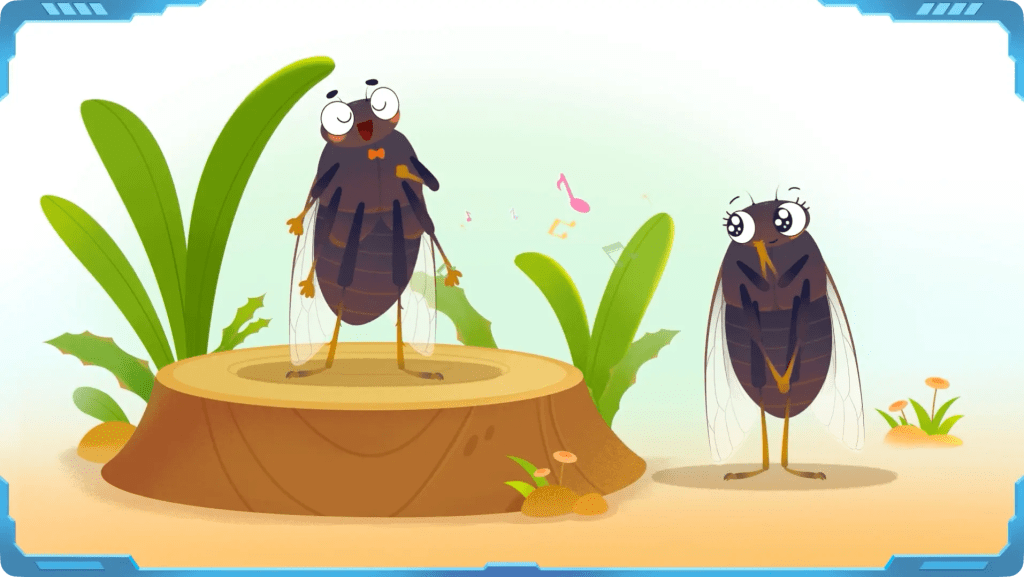
Other insects use different body parts to join the symphony. Crickets produce their familiar chirping sounds by rubbing their wings together. Grasshoppers utilize a similar method by rubbing their long legs against their wings. These vibrations move through the air to create the distinct songs we hear in our backyards during the summer months.
What is the science behind buzzing and air vibration?
Not all singing insects rely on friction to be heard. Some species make sounds through the rapid movement of air.
Mosquitoes and flies create their signature buzzing noises by flapping their wings against the air at incredible speeds. A mosquito can flap its wings over 500 times per second, while a fly flaps more than 300 times per second. This difference in speed is why a mosquito’s buzz has a higher pitch than a fly’s buzz.

Even more unusual methods of sound production exist in the insect kingdom. The hissing cockroach does not use wings or legs to make noise. Instead, it squeezes air out of its body to create a hissing sound that works much like an air pump.
Butterflies also flap their wings, but they move so slowly that the sound they produce is beyond the range of human hearing. Together, these diverse methods create a complex nature symphony that fills our environment with energy.
Fun Fact
- A Cicada nymph lives underground for many years, sometimes even 17 years, before it finally crawls out to sing.
- A thirsty Cicada uses its straw-like mouth to drink sweet sap from trees all day long.
- A Cricket does not have a voice; it makes music by rubbing its wings together like a tiny violin.
- The wings of a Cricket have special bumps and scrapers that create a “chirp” sound when they touch.
- A Madagascar Hissing Cockroach can hiss in three different ways to talk to friends or scare away enemies.
Vocabulary
- Bioacoustics: The branch of science that explores how living organisms, such as insects, produce and perceive unique sounds within their environment.
- Tymbal: A specialized sound-producing organ located on the abdomen of a cicada that creates loud noises through rapid vibration.
- Friction: The physical action of rubbing two body parts together—such as wings or legs—to create the vibrations necessary for chirping or singing.
- Pitch: The quality of a sound governed by the rate of vibrations; for example, the high-speed wing flapping of a mosquito creates a higher pitch than that of a fly.
- Human Hearing Range: The specific span of sound frequencies that people can perceive; some insect sounds, like the slow flapping of butterfly wings, fall outside this range.