
What Are the Facts About Insect Metamorphosis?
Are you looking for an easy way to teach your child about insect metamorphosis? We’ve put together a set of free materials that parents and teachers can use right away. In this lesson, your child will dive into the fascinating world of biological transformation.
We’ll explore the incredible stages of growth that insects experience during their lives. Explore science in a more engaging way with captivating 3D videos and interactive quizzes. Download our app to get started!
Table of Contents
What You Will Learn From This Lesson
- Some insects experience four distinct stages during complete metamorphosis.
- Incomplete metamorphosis involves three stages including egg, nymph, and adult.
- Nymphs grow into adults through several rounds of molting.
- Growing insects become vulnerable when shedding their old outer skin.
What happens during complete metamorphosis?
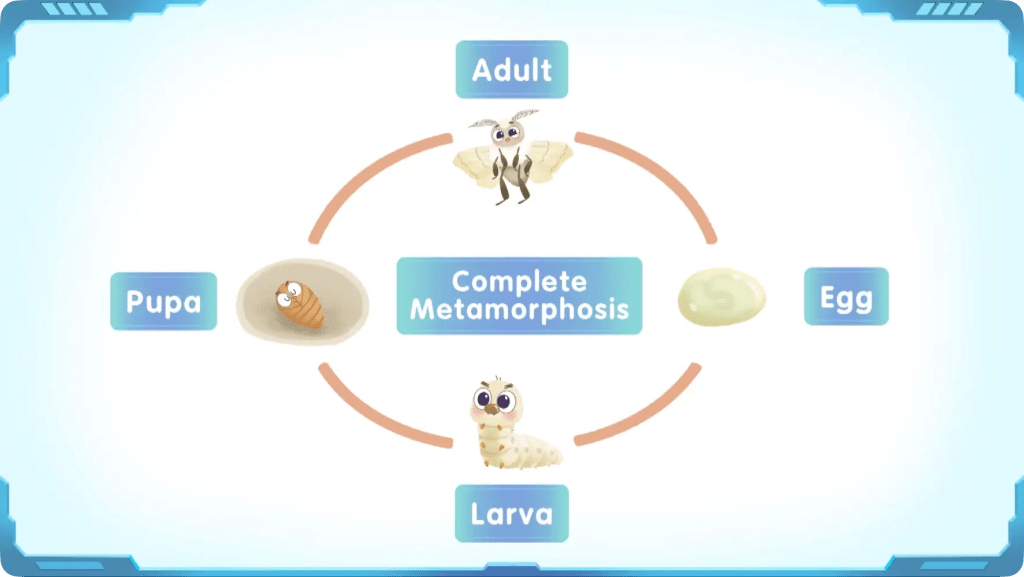
Biological transformation in the insect world is defined as a dramatic change of form that occurs as an animal matures. This process is known as insect metamorphosis. Many common species, such as butterflies, moths, and silkworms, undergo a four-stage journey known as complete metamorphosis.
The life cycle begins as an egg and progresses to the larva stage, which is commonly seen as a caterpillar or silkworm. After this period of growth, the insect enters the pupal stage, where it undergoes a slow and significant transformation. Finally, the insect emerges as an adult, often looking completely different from its younger form.
What happens during incomplete metamorphosis?
Not all insects go through four stages. Some species like grasshoppers and cicadas experience a three-stage cycle called incomplete metamorphosis. This cycle consists of the egg, the nymph, and the adult. Unlike larvae, nymphs often look like smaller versions of their adult parents but lack fully developed wings and legs.

To reach maturity, a nymph must go through several rounds of molting, which is the process of shedding an old outer skin to grow larger. During this time, the insect is quite vulnerable and must remain extra careful as its body becomes stronger. Over several years for some species like the cicada, the nymphal stage eventually concludes when the insect develops strong wings and officially becomes a flying adult.
Fun Fact
- The Doodlebug always walks backward and hides at the bottom of its pit like a tiny sand monster.
- The Housefly spits on dry food to turn it into a “soup” before slurping it up.
- A Mosquito flaps its wings almost 600 times every second, which creates that annoying “bzzz” sound.
- The Monarch Butterfly is a world-famous traveler that flies thousands of miles to find a warm winter home.
- A baby Monarch caterpillar eats its own eggshell as its very first meal to get strong and grow.
- The Silkworm spins a cozy, protective house called a cocoon made of one single, long thread of silk.
Vocabulary
- Metamorphosis: A dramatic biological transformation in which an insect undergoes a significant change of form as it matures from a young organism into an adult.
- Complete Metamorphosis: A four-stage life cycle common to species like butterflies and silkworms, consisting of the egg, larva, pupa, and adult stages.
- Incomplete Metamorphosis: A three-stage life cycle experienced by insects such as grasshoppers and cicadas, involving the egg, nymph, and adult stages.
- Larva: The second stage of complete metamorphosis, often appearing as a caterpillar or silkworm, which focuses primarily on growth before entering the pupal stage.
- Pupa: The third stage of complete metamorphosis, during which the insect undergoes a slow and significant internal transformation into its adult form.
- Nymph: The young stage of an insect undergoing incomplete metamorphosis; nymphs typically resemble smaller versions of their parents but lack fully developed wings and legs.
- Molting: The biological process of shedding an old outer skin to allow a growing insect to increase in size.