
What Is Elastic Force?
Are you looking for an easy way to teach your child about elastic force? We’ve put together a set of free materials that parents and teachers can use right away. In this lesson, your child will dive into the fascinating world of mechanics.
We’ll explore how invisible forces allow deformed objects to return to their original shapes. Explore science in a more engaging way with captivating 3D videos and interactive quizzes. Download our app to get started!
Table of Contents
What You Will Learn From This Lesson
- Elastic force helps materials regain their original shapes.
- Deformation strength determines the magnitude of elastic force.
What is elastic force?
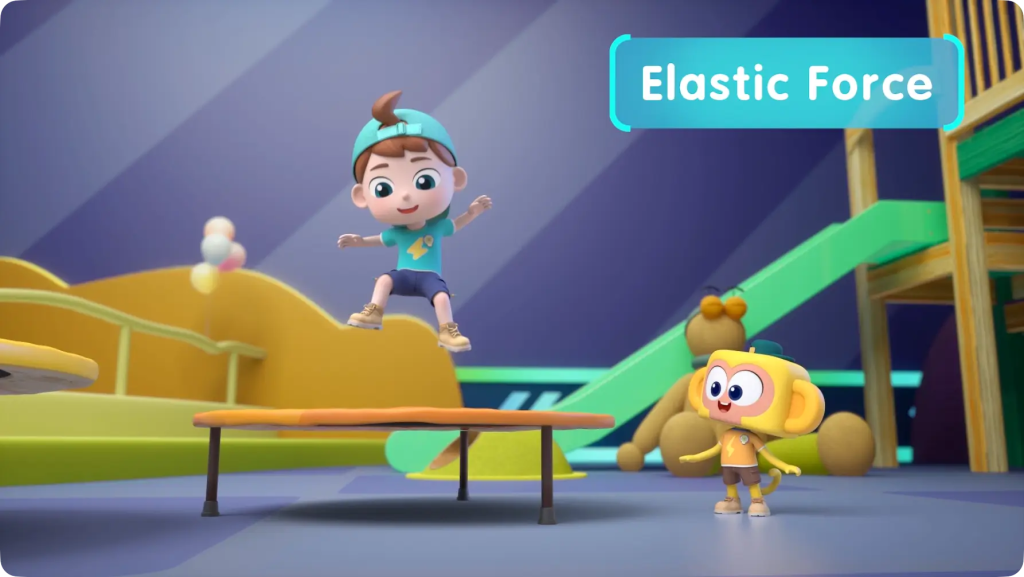
In the study of physics, forces are often invisible interactions that occur when objects push, pull, or compress one another. The elastic force is a specific type of force that allows certain materials to return to their original shapes after they have been deformed. This phenomenon explains why a trampoline surface remains bouncy rather than staying stretched out after a person jumps on it.
When an object is compressed or stretched, it undergoes a change in shape. The resulting elastic force acts as a restorative power that pulls or pushes the material back to its starting position. This invisible work is happening every time a flexible object is manipulated by an outside force.
What is the strength of elastic interactions?
The magnitude of an elastic force is not always the same and depends on specific physical factors. Scientific observation shows that the strength of this force is determined by the degree of deformation.
When a material is stretched or compressed significantly, it produces a much greater force compared to when it is only slightly moved.
These principles are fundamental to understanding the physics behind many common household items and playground equipment.
Fun Fact
- Trampolines use physics to push you high into the air as the surface snaps back.
- Elastic force acts like an invisible hand that pulls a stretched object back to normal.
- A Spring is a master of “bounce back”—no matter how much you pull or squish it, it always tries to return to its original shape.
- A car seat uses hidden springs to act like tiny cushions that soak up bumps so you don’t feel them.
- A weighing scale uses a spring to “feel” how heavy you are by measuring how much you can squish the metal coil down.
Vocabulary
- Elastic Force: A specific type of restorative force that allows certain materials to return to their original shapes after they have been stretched, compressed, or deformed by an outside interaction.
- Deformation: The change in an object’s physical shape that occurs when it is manipulated by a push, pull, or compression force.
- Restorative Power: The action of the elastic force that pulls or pushes a material back to its starting position once the external force is removed.
- Magnitude: The strength or size of a force; in elastic interactions, the magnitude depends on the degree of deformation applied to the object.
- Compression: The act of pressing or squeezing a material together, which triggers an elastic force that pushes outward to restore the object’s shape.
- Stretching: The act of pulling a material apart, which triggers an elastic force that pulls inward to return the object to its original length.