
What Is Inertia?
Are you looking for an easy way to teach your child about inertia? We’ve put together a set of free materials that parents and teachers can use right away. In this lesson, your child will dive into the fascinating world of classical mechanics.
We’ll explore how objects resist changes to their state of motion or rest. Explore science in a more engaging way with captivating 3D videos and interactive quizzes. Download our app to get started!
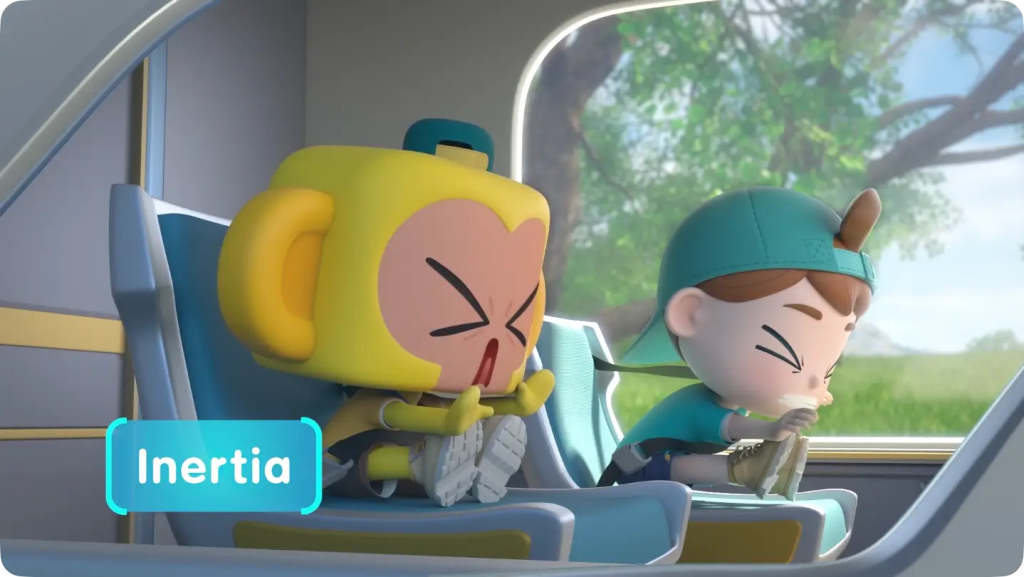
Table of Contents
What You Will Learn From This Lesson
- Inertia keeps moving objects in motion and stationary objects at rest.
- Every physical object in the world possesses the property of inertia.
What is inertia?
In the study of physics, the tendency of an object to keep moving or stay in place is known as inertia. This property is a fundamental characteristic of all matter in the universe.
Whether an object is currently in motion or sitting perfectly still, it possesses inertia that resists any sudden change to its current state.
A common example of this occurs when a moving vehicle comes to a sudden halt. While the car stops, the passengers’ bodies continue to move forward because of their inertia.
This is the primary reason why seat belts are such a critical safety feature in North American vehicles. Seat belts provide an external force that safely overcomes the body’s natural tendency to keep gliding forward.
How does inertia affect objects?
Inertia applies to every object regardless of its speed or activity level. For instance, when a paper airplane is thrown into the air, inertia is what keeps it gliding through the sky even after it leaves your hand. Without this property, the plane would not be able to maintain its path through the air.
Similarly, objects that are not moving also exhibit inertia to stay exactly where they are. If a truck speeds forward while carrying a stationary car, that car’s inertia tries to keep it in its original place. From household furniture to large machinery, everything around us follows these rules of physics.
Fun Fact
- Inertia is a secret rule of the universe that says objects are actually very lazy—they want to keep doing exactly what they are already doing!
- The “Stay Put” Power means that if an object is sitting still, its inertia makes it want to stay stuck in that same spot forever unless something gives it a big push.
- The “Keep Going” Power means that once an object is moving (like a paper airplane), it wants to keep gliding in a straight line forever until something stops it.
- Seat Belts are inertia-fighters; when a car stops fast, your body’s inertia tries to keep you flying forward, but the seat belt provides the “stop” force to keep you safe.
Vocabulary
- Inertia: The natural tendency of an object to resist any sudden change to its current state, whether it is currently moving or sitting perfectly still.
- External Force: An outside push or pull, such as a seat belt, that is required to safely overcome an object’s inertia and change its state of motion.
- Gliding: The act of an object, like a paper airplane, maintaining its path through the air due to the property of inertia after being thrown.
- Stationary: A state where an object is not moving; its inertia works to keep it in its original place even if the surface beneath it begins to move.
- State of Motion: The current activity level of an object; inertia resists changes to this state, making it take effort to start moving or force to stop.