
What Is Pitch?
Are you looking for an easy way to teach your child about how sounds can be high or low? We’ve put together a set of free materials that parents and teachers can use right away. In this lesson, your child will dive into the fascinating world of sounds.
We’ll explore how the speed of vibrations creates different musical notes and how the human ear hears them. Explore science in a more engaging way with captivating 3D videos and interactive quizzes. Download our app to get started!
Table of Contents
What You Will Learn From This Lesson
- Pitch describes the highness or lowness of sound.
- Frequency determines the pitch of a sound.
The relationship between vibration and pitch
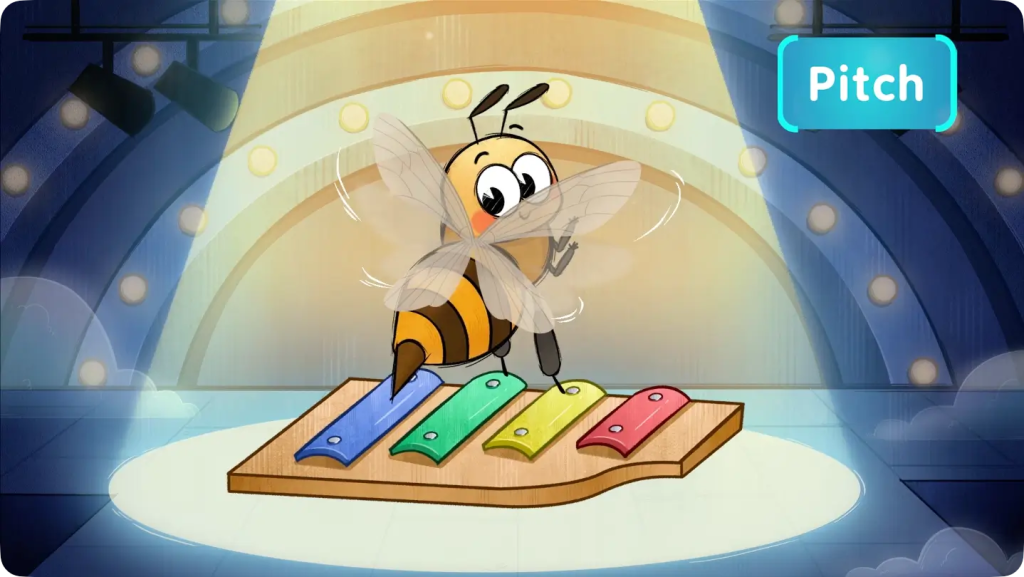
Pitch is the quality that makes a sound seem high or low. Whether a sound has a high pitch or a low pitch depends entirely on how fast an object vibrates. When an object vibrates very quickly, it creates a high-pitched sound. If the vibration is slower, the resulting pitch is lower.

We use the term frequency to describe how fast something vibrates. Frequency is measured in a unit called hertz.
- High Frequency: Faster vibrations result in a higher frequency and a higher pitch.
- Low Frequency: Slower vibrations result in a lower frequency and a lower pitch.
Pitch in music and the environment
In the world of music, pitch is essential for creating melodies and harmonies. Musicians often use tools like a tuning fork, which produces a tone at a very specific pitch, to ensure their instruments are in tune. If a piano is out of tune, a musician must adjust the frequency of the strings until the pitch is correct again.
You can observe how pitch changes in your daily life through simple activities:
- Water levels: When pouring water into a container, you may notice the sound getting higher. This is because the water level affects the frequency of the vibration.
- Human hearing: Humans can hear a wide range of pitches, typically between 20 and 20,000 hertz. However, there are many sounds in nature that fall outside of this range that we cannot hear at all.
- String instruments: Changing the tension or length of a string changes how fast it vibrates, which in turn changes its pitch.
Fun Fact
- The faster an object shakes back and forth, the higher the note you will hear.
- You can make a “glass harp” by filling jars with different amounts of water to change their pitch.
- Some animals can hear high-pitched sounds that are totally silent to humans.
- When you tighten a guitar string, you are increasing its frequency to make a higher pitch.
Vocabulary
- Pitch: The perceived highness or lowness of a sound, which is determined by the speed of the vibrations producing it.
- Frequency: The specific rate at which an object vibrates; it is the physical measurement that dictates the pitch we hear.
- Hertz: The standard scientific unit used to measure frequency, representing the number of vibrations per second.
- Vibration: The rapid, repeating back-and-forth motion of an object that generates sound waves in the surrounding medium.
- Tension: The tightness of a string or surface; increasing tension causes faster vibrations, which results in a higher frequency and pitch.
- Auditory Range: The span of frequencies that the human ear is capable of detecting, typically ranging from 20 to 20,000 hertz.
- Melody: A sequence of musical notes of different pitches that are perceived by the listener as a single, recognizable entity.