
What Is Reflection Meaning?
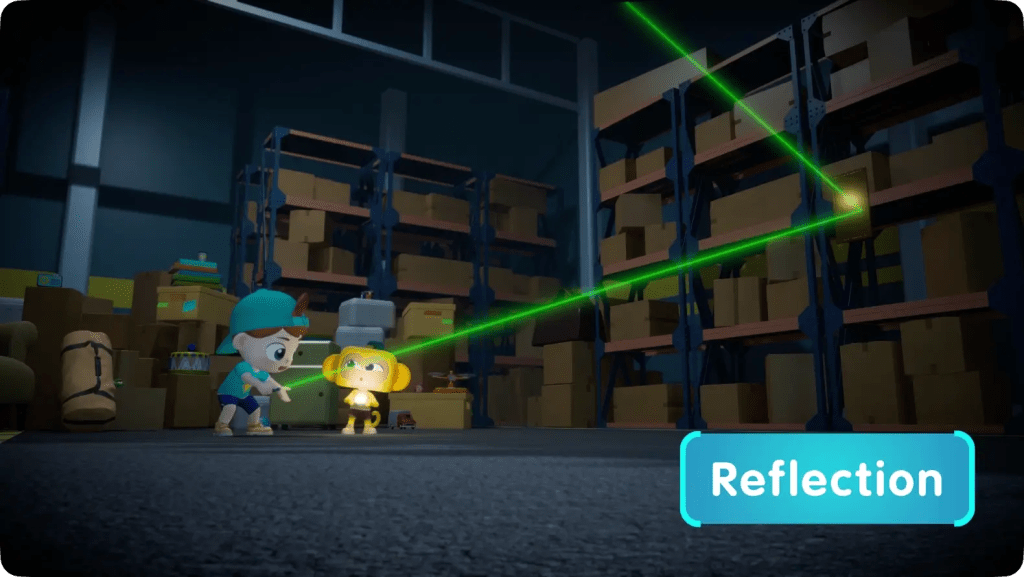
Are you looking for an easy way to teach your child about reflection? We’ve put together a set of free materials that parents and teachers can use right away. In this lesson, your child will dive into the fascinating world of optics.
We’ll explore how light bounces off surfaces and allows us to see colors and objects. Explore science in a more engaging way with captivating 3D videos and interactive quizzes. Download our app to get started!
Table of Contents
What You Will Learn From This Lesson
- Reflection occurs when light bounces off a surface.
- Surfaces determine if reflection is specular or diffuse.
How we see through reflection?
Reflection occurs when light hits a surface and bounces off that surface. This is very similar to how a ball bounces off a wall. We are able to see objects around us because light reflects off them and enters our eyes.
While some things like lamps produce their own light, most objects, like flowers or drums, are visible only because they reflect light from other sources.
Reflection also explains why we see different colors. Sunlight actually consists of many different colors, including red, orange, yellow, green, blue, indigo, and violet.
An object appears to be a certain color because it absorbs most colors and reflects only one. For instance, a flower looks red because it absorbs all other colors and reflects only red light into our eyes.
Specular versus diffuse reflection
The way light reflects depends entirely on the texture of the surface it hits. When parallel light rays hit a perfectly smooth surface, the reflected rays remain parallel. This is called specular reflection.
This type of reflection happens with mirrors or calm puddles of water, creating a clear and bright image.

Most objects have rough surfaces, which cause diffuse reflection. When light hits a rough surface, the reflected rays go in many different directions. This allows us to see an object, like a blackboard, from many different angles in a room. We can see these principles in action in several ways:
- Sideview Mirrors: Mirrors use specular reflection to show clear images of cars behind us.
- Rainy Nights: Water puddles look brighter because they produce specular reflection while the rough ground produces diffuse reflection.
- Blackboards: The rough surface of a board ensures that every student in a classroom can see what is written.
Fun Fact
- White sunlight is actually a mix of seven different colors of light.
- Without reflection, we wouldn’t be able to see anything that doesn’t glow.
- A funhouse mirror is a “shape-shifter” that uses bumps and dents to turn you into a cartoon version of yourself.
- A convex mirror is a “wide-angle eye” that lets you see around corners and behind your car. Stores use these “security bubbles” so one person can watch every aisle at the same time.
- Objects in a convex mirror are “closer than they appear” because the mirror shrinks them to fit more into the view.
Vocabulary
- Reflection: The process that occurs when light hits a surface and bounces off, similar to a ball bouncing off a wall; this allows us to see objects and colors.
- Optics: The fascinating branch of science that explores how light behaves, reflects, and allows us to see the world around us.
- Specular Reflection: A type of reflection that happens on perfectly smooth surfaces, like mirrors, where parallel light rays bounce back and remain parallel to create a clear image.
- Diffuse Reflection: A type of reflection that occurs on rough surfaces, causing light rays to bounce in many different directions so an object can be seen from many angles.
- Parallel Light Rays: Light beams that travel in the same direction; their behavior after hitting a surface determines whether a reflection is clear or blurry.