
How Does the Plant Life Cycle Work?
Are you looking for an easy way to teach your child about how plants grow? We’ve put together a set of free materials that parents and teachers can use right away. In this lesson, your child will dive into the fascinating world of botany.
We’ll explore the journey from a tiny seed to a fruit-bearing plant and the different ways plants reproduce. Explore science in a more engaging way with captivating 3D videos and interactive quizzes. Download our app to get started!
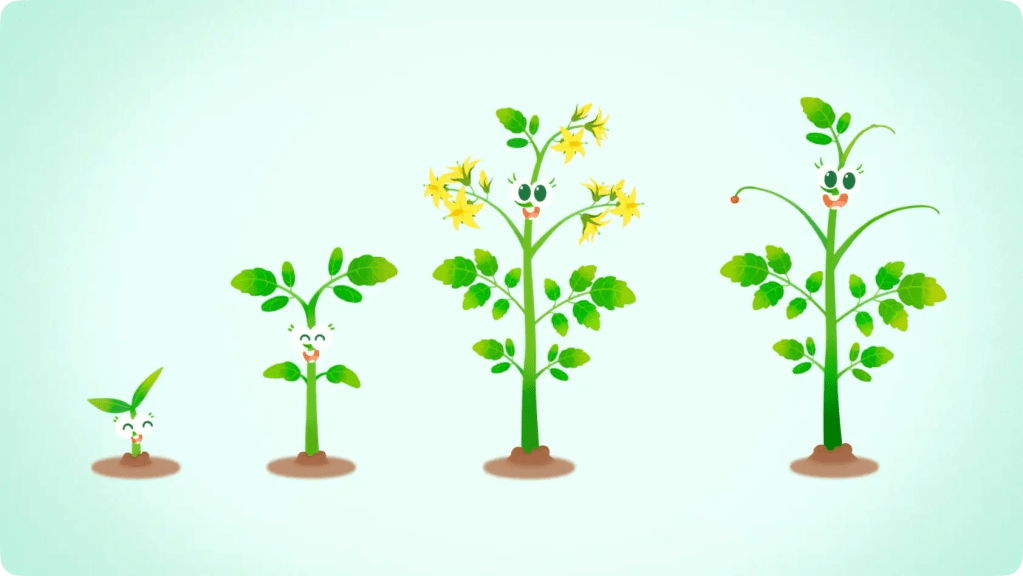
Table of Contents
What You Will Learn From This Lesson
- Seeds require three specific conditions to germinate.
- Plants reproduce using either seeds or spores.
How many stages does plant growth need?
The life cycle of many plants, such as a tomato, begins with a tiny seed. However, growing a plant takes time and patience. The first major step in the life cycle is germination.
For a seed to germinate and break through the soil to become a seedling, it needs three ideal conditions:
- Suitable Temperature: Seeds will not sprout if it is too hot or too cold.
- Moisture: Seeds need just the right amount of water to start growing.
- Air: Even when buried, seeds need air. Loosening the soil helps more air reach the seed.

Once the seed germinates, it grows into a seedling. As the plant continues to mature, it will eventually bloom with flowers. These flowers then bear fruit, which contain the seeds needed to start the entire cycle over again.
Different ways plants reproduce
While many of the yummy fruits we eat, like tomatoes, reproduce by seeds, not all plants follow this path. Some plants have developed other magical ways to create new life.
There are two primary ways plants reproduce:
- Reproduction by Seeds: This is the most common method for flowering plants and trees. The plant grows from a seed, produces its own seeds, and the cycle repeats.
- Reproduction by Spores: Some plants, such as fishbone ferns and mosses, do not have seeds at all. Instead, they have little round structures called spore sacs. Inside these sacs are many tiny spores. When a spore sac opens, the spores scatter into the air and fall to the ground. Once they land, they grow directly into new plants.

Whether starting from a seed or a spore, the growth of a plant is a slow and steady process that requires the right environment to succeed.
Fun Fact
- Seeds are picky! They won’t wake up and grow if the “bed” of soil is too hot or too cold.
- Loosening the soil with a shovel is like opening a window for buried seeds to breathe.
- Not every plant comes from a seed; some grow from tiny “dust-like” particles called spores.
- Ferns hide their “baby plants” in little sacs on the back of their leaves.
Vocabulary
- Germination: The physiological process where a seed recovers from dormancy and begins to sprout after being exposed to suitable environmental conditions.
- Seedling: A young plant that has recently emerged from its seed coat and begun to develop its first true leaves and roots.
- Moisture: The essential amount of water required to soften the seed coat and activate the internal biological processes of the embryo.
- Aeration: The presence of air within the soil, which is necessary for the seed to breathe; this is often improved by loosening the soil.
- Spores: Microscopic, dust-like reproductive units used by non-flowering plants, such as ferns and mosses, to create new life without the use of seeds.
- Spore Sacs: Specialized structures that house and protect spores until they are mature and ready to be released into the environment.
- Life Cycle: The entire sequence of stages a plant undergoes from its start as a seed or spore through maturity, flowering, and the production of new offspring.