
What Are Plant Seeds?

Are you looking for an easy way to teach your child about plant seeds? We’ve put together a set of free materials that parents and teachers can use right away. In this lesson, your child will dive into the fascinating world of seeds.
We’ll explore how tiny seeds contain everything needed to grow a new plant and the clever ways they travel. Explore science in a more engaging way with captivating 3D videos and interactive quizzes. Download our app to get started!
Table of Contents
What You Will Learn From This Lesson
- Seeds consist of a coat, embryo, and endosperm.
- Plants use wind, water, and animals to spread seeds.
How does a tiny seed grow into a plant?
Seeds are the reproductive organs of plants, and every part of a plant develops from one. Although they are small, seeds are made up of three essential parts that work together: the seed coat, the embryo, and the endosperm. The seed coat is the outer layer that keeps the inside safe from harm.
Inside the protective coat, the embryo is the part that will eventually grow into a new plant. To do this, it needs energy, which is provided by the endosperm. During germination, the endosperm supplies nutrients to help the embryo break through the soil and sprout.
As long as the conditions are right, even a small seed can grow in extremely harsh environments.
How do seeds travel?
Most plants drop their fruit nearby when it is ripe, but many plants have developed special ways to spread their seeds further away to find new places to grow. This prevents too many plants from crowded into one spot.
Plants use several clever methods for seed dispersal:
- Wind: Dandelion seeds are lightweight and designed to fly through the air like tiny umbrellas.
- Water: Coconuts act like brave sailors; they can float on the sea and ride the waves to reach distant shores.
- Self-Projectile: The squirting cucumber is a unique plant that shoots its seeds out like a rocket when it ripens.
- Hitchhiking: Some plants, like the cocklebur, have seeds with prickly barbs. These stick to the fur of animals or the clothes of people, allowing the seed to catch a ride to a new location.
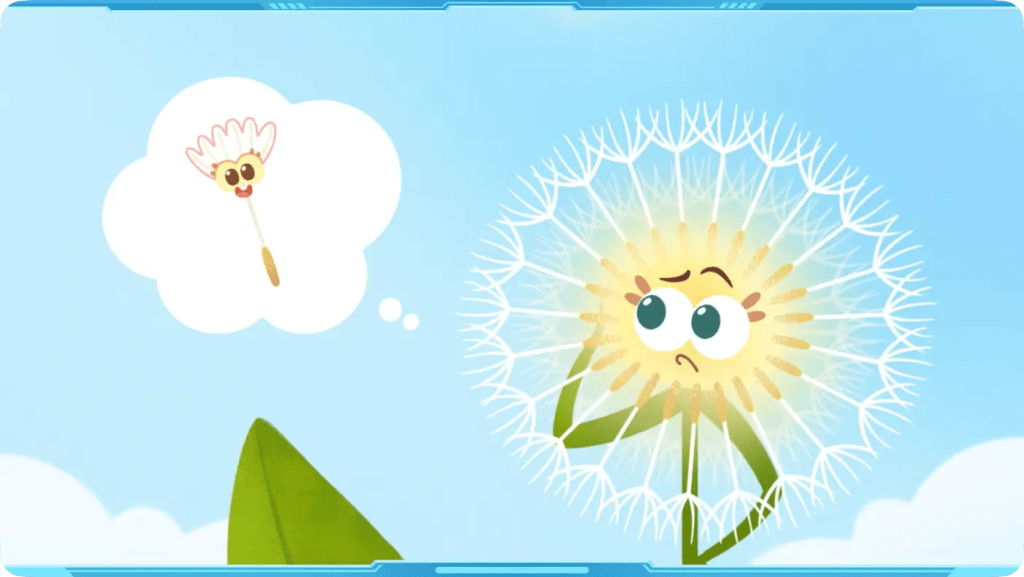
By hitching rides or flying through the sky, seeds ensure that plants can spread across the entire planet.
Fun Fact
- Bread is made from wheat, which grows from seeds that droop when they are ripe.
- A seed is like a tiny “survival kit” with its own food supply .
- Dandelion seeds are natural gliders that use the wind to travel long distances.
- Some seeds, like the cocklebur, use “velcro-like” hooks to travel on your clothes.
- Squirting cucumbers can actually “sneeze” their seeds out to spread them.
Vocabulary
- Seed: The mature ovule of a flowering plant that serves as the primary unit of reproduction and contains a dormant embryo.
- Seed Coat: The resilient outer layer of a seed that protects the internal structures from dehydration, pathogens, and physical damage.
- Embryo: The rudimentary plant contained within the seed which consists of the precursor tissues for the future roots, stems, and leaves.
- Endosperm: A specialized tissue that functions as a nutrient-rich energy reserve to support the embryo during its initial growth phase.
- Germination: The physiological process through which a seed recovers from dormancy and begins to sprout into a seedling.
- Seed Dispersal: The ecological mechanism of transporting seeds away from the parent plant to ensure a wider distribution and reduce competition.
- Ballochory: A self-projectile method of dispersal where plants use internal tension to forcefully eject seeds at high speeds.
- Epizoochory: A hitchhiking dispersal strategy where seeds use hooks or barbs to attach to the exterior of passing animals or humans.
- Anemochory: The transport of seeds by wind, facilitated by aerodynamic structures such as plumes or wings.