
What Sort of Flowers Are There?

Are you looking for an easy way to teach your child about flowers? We’ve put together a set of free materials that parents and teachers can use right away. In this lesson, your child will dive into the fascinating world of flowers.
We’ll explore how flowers are built and the clever ways they spread their pollen to create new life. Explore science in a more engaging way with captivating 3D videos and interactive quizzes. Download our app to get started!
Table of Contents
What You Will Learn From This Lesson
- Flowers have five main structural parts.
- Pollination occurs via animals, wind, or water.
What are the parts of a flower?
A typical flower is made up of five primary parts: the pedicel, receptacle, calyx, corolla, and the reproductive stamens and pistils. The pedicel acts like a bridge connecting the flower to the stem. At its top is the receptacle, which supports the upper parts of the flower.
The calyx grows along the edge of the receptacle and protects the petals before they bloom. All the petals together are called the corolla. Once the flower blooms, you can see the stamens, which produce pollen, and the pistils, which receive it.

Usually, a flower has more stamens than pistils. Sometimes, many small flowers cluster together on a single axis, which is called an inflorescence.
How do flowers move their pollen?
For a plant to reproduce, pollen must travel from the stamen to the pistil in a process called pollination. Plants are very clever and use different methods to move their pollen depending on their environment.
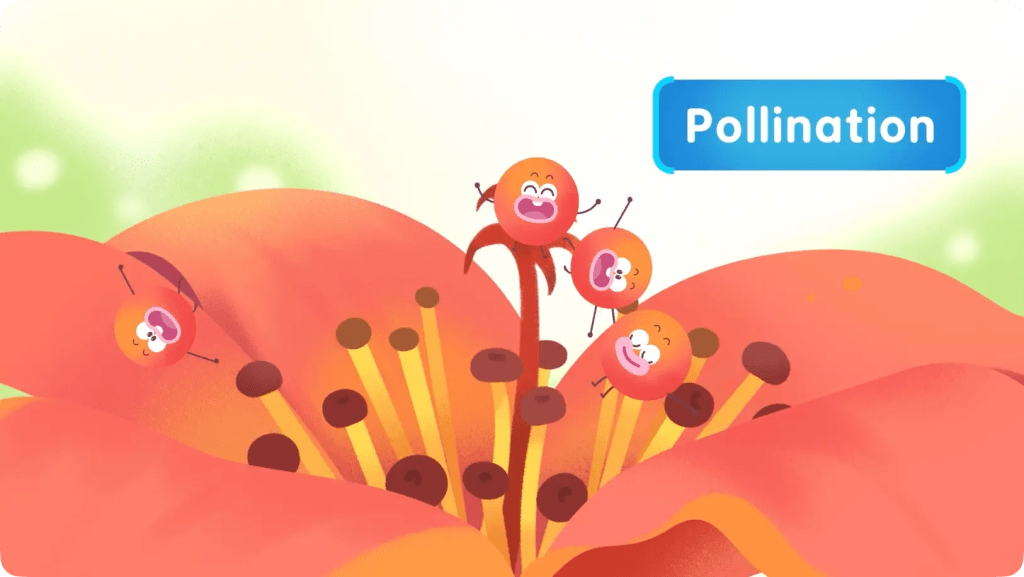
Flowers are often categorized by how they are pollinated:
- Animal-pollinated: Many flowers rely on insects like bees to carry pollen from one bloom to another.
- Wind-pollinated: Plants like the Japanese white birch have light, dry pollen that travels with the wind like an adventurer until it lands on a pistil.
- Water-pollinated: Aquatic plants like hornworts release pollen that floats on the surface or slowly sinks through the water to reach other flowers.
Because flowers often bloom for only a short time, it is important to appreciate and protect them rather than picking them.
Fun Fact
- The pedicel is more than a stem; it’s the vital “bridge” for the flower’s resources.
- An “inflorescence” is actually a group of many tiny flowers working together.
- Not all flowers smell sweet; wind-pollinated flowers often don’t need a scent to attract insects.
- Birch tree pollen is designed to be a “traveler” that can fly through the air.
- Hornworts use the flow of water to ensure their seeds can grow for the next generation.
Vocabulary
- Inflorescence: A cluster of many small flowers arranged on a common axis.
- Pedicel: The vital “bridge” that connects the flower to the stem, acting as a transport link for resources.
- Receptacle: The base located at the top of the pedicel that supports all the upper parts of the flower.
- Calyx: The protective part that grows along the edge of the receptacle to shield the petals before they bloom.
- Stamen: The reproductive part of the flower responsible for producing pollen; flowers usually have more of these than pistils.
- Pistil: The reproductive part of the flower that receives pollen to help create new life.
- Pollination: The process where pollen travels from the stamen to the pistil, allowing the plant to reproduce.