
Why Do Plants Have Leaves?
Are you looking for an easy way to teach your child about plant leaves? We’ve put together a set of free materials that parents and teachers can use right away. In this lesson, your child will dive into the fascinating world of leaves.
We’ll explore how leaves act as food factories and cooling systems for plants. Explore science in a more engaging way with captivating 3D videos and interactive quizzes. Download our app to get started!
Table of Contents
What You Will Learn From This Lesson
- Leaves consist of the stipule, the petiole, and the leaf blade.
- Photosynthesis and transpiration are essential for plant survival.
How do leaves differ in structure?
A typical leaf is made up of three main parts: the stipule, the petiole, and the leaf blade. The stipules usually come in pairs at the base, acting as if they are holding up the rest of the leaf. While most leaves have these three parts, some plants like lilacs and lilies do not have stipules at all.
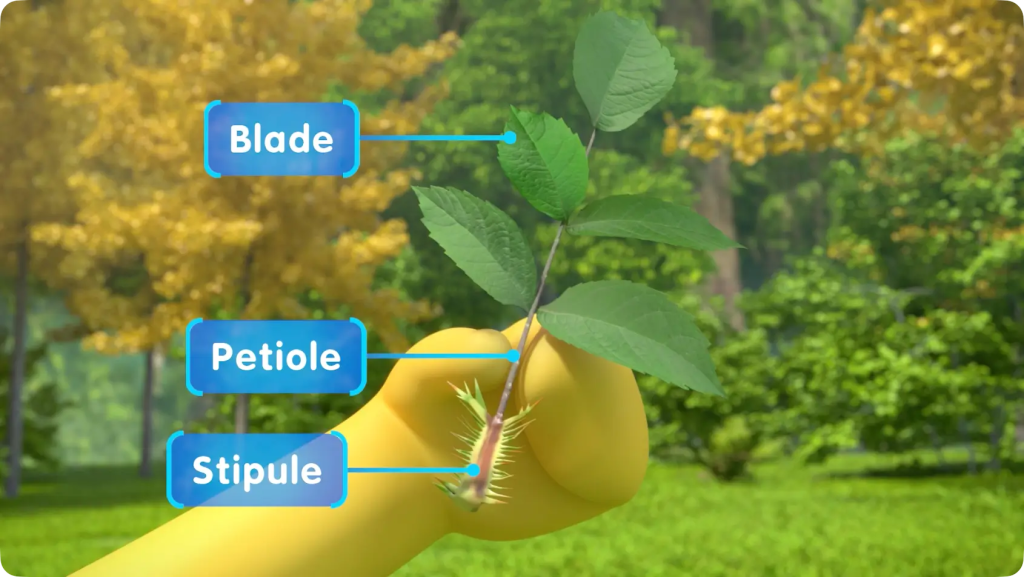
Leaves come in two primary forms based on their structure:
- Simple leaves: These have one petiole and one single blade, such as a lilac leaf.
- Compound leaves: These have one petiole with two or more leaflets on it, such as a pea leaf or a rose leaf.
What are the functions of leaves?
Leaves are not just for decoration; they perform the most important jobs for the plant’s survival through two cool abilities: photosynthesis and transpiration. Through photosynthesis, leaves take in sunlight to make nutrients for the plant. During this process, they also release the oxygen that humans and animals need to breathe.

Leaves also have a special way to protect themselves from getting too hot under strong sunlight, called transpiration:
- Stomata: These are tiny pores on the surface of the leaf.
- Evaporation: Water inside the plant evaporates through these stomata and is lost to the air.
- Cooling: This process works like “sweating,” taking away heat and reducing the surface temperature of the leaf so the sun does not hurt it.

By providing food, fresh air, and climate control, leaves are vital to the health of the plant and everyone on Earth.
Fun Fact
- Stipules often come in pairs and help support the rest of the leaf structure.
- Leaves act like “food factories” that turn sunlight into energy.
- When a plant “sweats” through its leaves, it is actually cooling itself down.
- Much of the oxygen you breathe every day is produced right inside of leaves.
Vocabulary
- Leaf Blade: The main, flat part of the leaf that captures sunlight to help the plant thrive.
- Petiole: The stalk that connects the leaf blade to the stem, acting as a bridge for nutrients and support.
- Stipule: Small, leaf-like structures that usually come in pairs at the base of the petiole to help support the rest of the leaf.
- Photosynthesis: The incredible process where leaves act as “food factories,” using sunlight to create nutrients while releasing oxygen for humans and animals to breathe.
- Transpiration: A plant’s version of “sweating,” where water evaporates through the leaves to take away heat and reduce the plant’s temperature.
- Stomata: Tiny, invisible pores on the leaf surface that allow water to escape during evaporation.
- Simple Leaf: A leaf form that consists of one petiole and a single, undivided blade, such as a lilac leaf.
- Compound Leaf: A leaf structure where one petiole holds two or more smaller leaflets, like those found on a rose or pea plant. [Image comparing simple and compound leaves]
- Leaflets: The individual mini-leaves that make up the blade of a compound leaf.