
How Is Coal Formed?
Are you looking for an easy way to teach your child about rocks and minerals? We’ve put together a set of free materials that parents and teachers can use right away. In this lesson, your child will dive into the fascinating world of coal formation.
We’ll explore the long process of plant remains turning into coal. Explore science in a more engaging way with captivating 3D videos and interactive quizzes. Download our app to get started!
Table of Contents
What you will learn from this lesson
- Coal forms over a very long process, taking millions of years.
- Anthracite is the oldest and highest-quality type of coal.
What is Coal?
Coal is a type of combustible organic rock that is also classified as a sedimentary rock. It is a resource that can burn. Coal originates from dead plants that lived hundreds of millions of years ago.
How is Coal Formed Over Time?
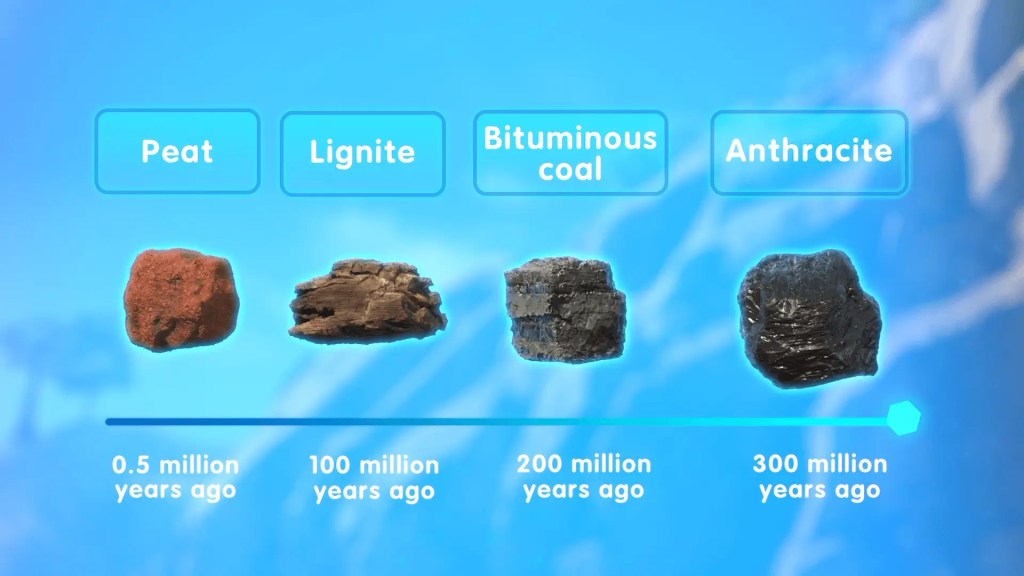
The formation of coal is a very long process, taking hundreds of millions of years. It began in ancient rainforests, such as those in the Carboniferous period about 300 million years ago. Dead plants sank to the bottom of swamps, where they were buried by sediment layers that blocked out air.
The buried plant matter was then decomposed by microbes. This initial material is called peat, which is the lowest-grade precursor to coal. Over tens of millions of years, the peat was compressed by high pressure and heat from the accumulating upper sediments, transforming it into lignite (also known as brown coal).
As more sediments accumulated, the lignite was further compressed. Over about 300 million years of high temperature and pressure, it gradually turned into bituminous coal or anthracite. The quality of the coal is determined by how early its formation period occurred; the earlier the period, the better the coal.
What Makes Anthracite Different?
Anthracite is known as the oldest and highest-quality coal. This is because its formation process takes over 300 million years. Unlike some younger coals, which are smoky, anthracite burns with little to no smoke. This makes it valuable for heating and industrial applications. Anthracite has a higher heat output compared to other types of coal.
Fun Fact
- Coal is a combustible rock that can burn and is formed from ancient dead plants.
- The formation of coal began in ancient rainforests that existed over 300 million years ago.
- Anthracite, the highest quality coal, takes more than 300 million years of high pressure and heat to fully form.
Vocabulary
- Combustible Organic Rock: A type of rock, like coal, that is made from old living things and can be burned.
- Sedimentary Rock: Rock that forms when layers of tiny pieces, like sand or plant remains, are squeezed and pressed together over a long time.
- Microbes: Very tiny living things that help break down dead plants. This is an important first step in forming coal.
- Peat: The first and lowest-quality material in the formation of coal. It is made of decomposed plant matter that collects in swamps.
- Lignite: A type of coal that forms when peat is squeezed by high pressure and heat for many millions of years. It is sometimes called brown coal.
- Bituminous Coal: A type of coal that forms after lignite has been under very high temperature and pressure for about 300 million years.
- Anthracite: The oldest and best quality of coal. It takes over 300 million years to form and burns cleanly with almost no smoke.