
What Are Rocks and Minerals?
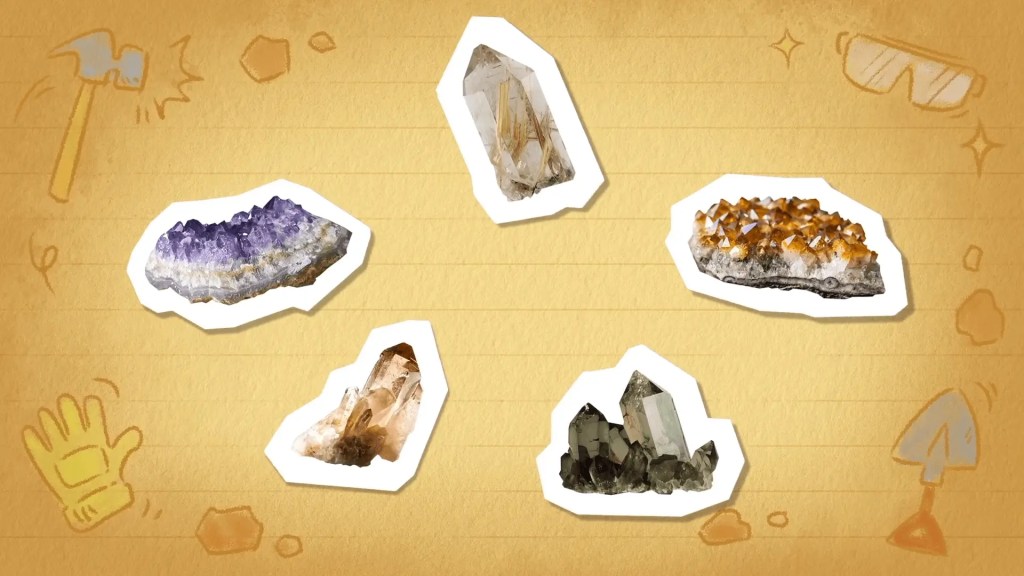
Are you looking for an easy way to teach your child about rocks and minerals? We’ve put together a set of free materials that parents and teachers can use right away.
In this lesson, your child will dive into the fascinating world of rocks and minerals. We’ll explore their distinct characteristics, identification methods, and formation. Explore science in a more engaging way with captivating 3D videos and interactive quizzes. Download our app to get started!
Table of Contents
What you will learn from this lesson
- Most rocks on Earth are made up of different minerals.
- Scientists use specific properties to identify minerals.
- Essential tools for collecting samples are a geological hammer and a shovel.
- Rocks and minerals are found in many common item
What Are Rocks and Minerals?
Most rocks on Earth are actually made up of different combinations of minerals. For example, the colorful spots seen within granite are the individual minerals that formed the rock. However, the minerals in some rocks can be very tiny and may be invisible to the naked eye.
How Are Minerals Identified?
A mineral is a naturally formed solid substance composed of elements that possess a specific crystal structure. This structure means the small units inside the mineral are lined up in a highly ordered pattern. Interestingly, a few rocks, like the natural glass obsidian, contain no minerals at all because they cooled too quickly for crystals to form.
Scientists use a set of specific properties to identify minerals, including their color, luster, and hardness. A mineral’s color can be classified into three types: idiochromatic, which is the mineral’s own color; allochromatic, which comes from impurities; or pseudochromatic, which is a false color caused by light diffraction. The most reliable way to find a mineral’s true color is by performing a streak test.
Other identifying properties include:
- Luster: This property describes how the mineral’s surface reflects light, such as a brass-yellow metallic luster seen in pyrite.
- Hardness: A mineral’s hardness is measured using the Mohs Hardness Scale, which consists of ten levels. A harder mineral will always be able to scratch a softer one in a scratch test.
- Cleavage and Fracture: This describes how a mineral breaks when force is applied. Some minerals, like mica, peel into thin sheets, while others, like calcite, break into rhomboid shapes.
What Tools Help Us Collect Rocks?
Anyone planning a trip to collect samples must bring the right tools and safety gear to prevent injury. The essential professional tools for collecting samples are a geological hammer and a shovel. The geological hammer has one end for hammering and the other for chipping away small samples.
A shovel is perfect for digging up samples from loose soil or along riverbanks. Collectors should also carry a hand lens, which is a small magnifying glass, to see the tiny details on rocks and minerals clearly. Once collected, samples should be cleaned, labeled with the time and location they were found, and stored in a specimen box for preservation.
Where Are Rocks and Minerals Found?
Minerals are easily spotted in everyday life. Many common items, including building tiles, metal tools, and works of art, are crafted from these natural materials. Some rocks and minerals are so rare and precious that they are used to make currency and jewelry.
Outdoor collecting must only happen in safe and permitted locations. It is important to remember that rocks and minerals serve as Earth’s history books. Every small stone carries a record of thousands of years of geological change.
Fun Fact
- Fluorite is the source of fluoride used in toothpaste to prevent cavities.
- Native sulfur has a distinct rotten egg odor and was once used in gunpowder.
- Heating vermiculite causes it to expand and twist around just like a worm.
Vocabulary
- Mineral: A naturally formed solid substance made of one or more elements that possesses a specific crystal structure.
- Crystal Structure: The highly ordered internal arrangement of small units within a mineral, lined up in a repetitive pattern.
- Mohs Hardness Scale: A scale introduced in 1812 to measure mineral hardness, consisting of ten levels.
- Streak: The color of the powder that is left behind when a mineral is rubbed across a white ceramic tile surface.
- Luster: A property that describes the way a mineral’s surface reflects light.
- Cleavage: The way a mineral splits in a specific direction when an external force is applied.
- Idiochromatic: A color category where the mineral’s color comes from its own inherent chemical composition.
- Allochromatic: A color category where the mineral’s color is caused by impurities.
- Pseudochromatic: A color category where the color is a false appearance caused by the diffraction of light.