
What is Graphite?
Are you looking for an easy way to teach your child about rocks and minerals? We’ve put together a set of free materials that parents and teachers can use right away. In this lesson, your child will dive into the fascinating world of graphite.
We’ll explore the structure and properties that make this mineral useful. Explore science in a more engaging way with captivating 3D videos and interactive quizzes. Download our app to get started!
What you will learn from this lesson
- Graphite is a soft, black, non-metallic mineral.
- Graphite layers of carbon atoms slide easily.
- Graphene is strong due to tight carbon bonding.
What mineral is in a Pencil?
Did you know the core of your pencil contains a mineral? The dark mark left on your paper is a mineral called graphite. Graphite is one of the softest minerals in the world, scoring only a 1 on the Mohs hardness scale. Because of its low hardness, graphite easily breaks off and leaves a mark, which is why it is perfect for writing and drawing.
Why is Graphite Slippery?
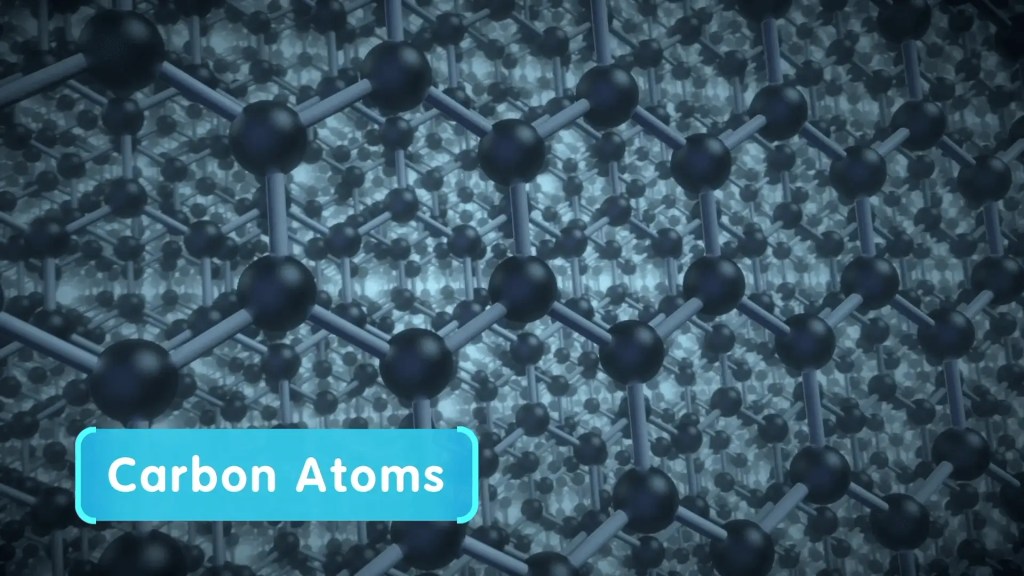
The soft and slippery feel of graphite is directly related to its unique layered structure. The carbon atoms within graphite are arranged in layers, which is called a layered structure. An amazing three million layers of carbon atoms can be found in just one millimeter of graphite. The layers of carbon atoms are held together loosely. Because the bonding is loose, the layers can slide over each other, which is why graphite feels slippery and is sometimes used as a lubricant.
What Makes Graphene So Strong and Flexible?
If graphite is separated into just a single layer of carbon atoms, the resulting material is called graphene. While the layers within graphite are loosely bonded, the carbon atoms within a single layer of graphene are tightly bonded together. This tight bonding forms a very stable structure, giving graphene remarkable strength.
Graphene is known for its excellent toughness. A sheet of graphene measuring 10 square feet can even support the weight of a cat. Because of this superior toughness, graphene can be used to make bendable screens.
Fun Fact
- Historically, shepherds used graphite to mark their sheep for over 400 years.
- Because graphite resists extreme heat, it protects parts on rockets and airplanes.
- Graphite is a rare non-metal mineral that can conduct electricity just like a metal.
Vocabulary
- Graphite: A soft, black, non-metallic mineral made entirely of carbon atoms, known for its slippery feel and ability to leave marks. It is one of the softest minerals in the world.
- Carbon Atom: The fundamental, tiny particles that bond together to form the structure of graphite.
- Mohs Hardness: A scale used to measure the scratch resistance or hardness of a mineral. Graphite has a very low Mohs hardness of 1.
- Graphene: A material created by separating graphite into a single layer of carbon atoms. It is known for its excellent toughness and stable structure.