
What is Halite?
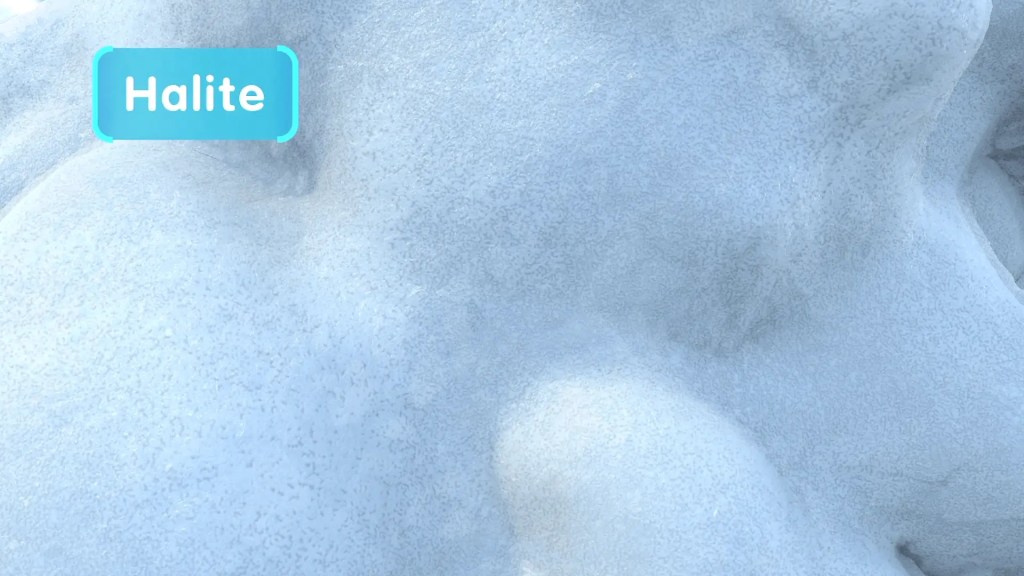
Are you looking for an easy way to teach your child about rocks and minerals? We’ve put together a set of free materials that parents and teachers can use right away. In this lesson, your child will dive into the fascinating world of halite.
We’ll explore the formation, uses, and properties of the mineral halite. Explore science in a more engaging way with captivating 3D videos and interactive quizzes. Download our app to get started!
Table of Contents
What you will learn from this lesson
- he skiHalite is made of sodium chloride.
- Halite forms when salty water evaporates.
- Halite is used as table salt and a deicer.
What Is Halite Made Of?
Halite is a mineral closely related to our everyday lives. It is mainly composed of sodium chloride. After processing, halite becomes the table salt we eat, which is essential as a flavor enhancer and preservative in our diets. Pure halite is typically colorless or white, but impurities can sometimes give it various colors. Halite can be identified by its white streak and has a Mohs hardness of 2.5. It also exhibits a vitreous luster.
How Does Halite Form?
The story of halite begins in ancient oceans that existed hundreds of millions of years ago. These oceans contained a large amount of dissolved halite. Plate movements caused the seawater to move to other places, which brought the water level down and turned the ocean into a salty lake. Halite crystals form when saline water, like ocean water or salty lake water, evaporates. As the salty lake water evaporates, halite gradually forms at the bottom of the lake or near the shore. This process explains why halite deposits are typically found in salt lakes or underground caves.
What Are Halite’s Uses and Shapes?
Halite has several uses beyond being processed into the table salt we use for food. For example, it is also used as a deicer. Halite deposits come in many distinct shapes and colors.
Halite crystals can be found in various forms:
- Some halite comes in cubic structures.
- Others are found in elongated shapes.
- Some halite deposits even look like leaves.
Another mineral, sylvite, is often found near halite deposits and is used in the production of fertilizer.
Fun Fact
- Halite is the mineral name for the sodium chloride we use as table salt to flavor food.
- Halite, which can be colorless or white, gets its many hues from other minerals mixed in.
- Halite forms when salty ocean or lake water evaporates in hot, dry conditions.
Vocabulary
- Halite: A chloride mineral made mostly of sodium chloride. It’s often called rock salt. This mineral forms when salty water evaporates.
- Sodium Chloride: The main ingredient in halite, which turns into table salt after processing.
- Plate Movements: The shifting of Earth’s outer layer that can trap sections of the ocean, creating salty lakes that eventually dry up.
- Evaporation: The process by which salty lake water turns into vapor. This action is often faster in hot weather. This process causes halite to slowly form crystals.
- Sylvite: A mineral often found near halite deposits. It is used specifically in the making of fertilizer.