
Ocean Food Chain
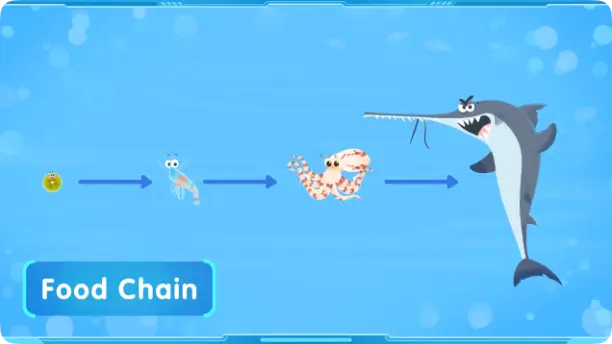
Are you looking for an easy way to teach your child about the ocean food chain? We’ve put together a set of free materials that parents and teachers can use right away. In this lesson, your child will dive into the fascinating world of marine ecosystems.
We’ll explore how marine life stays connected through the process of eating and getting eaten. Explore science in a more engaging way with captivating 3D videos and interactive quizzes. Download our app to get started!
Table of Contents
What You Will Learn From This Lesson
- Understand that an ocean food chain connects animals through their food sources.
- Identify producers as the starting point of energy in a marine ecosystem.
- Recognize that top predators have no natural hunters in their environment.
What is an ocean food chain?
In the animal kingdom, various creatures rely on each other to find their food. Scientists describe these connections as an ocean food chain. This system illustrates how energy moves from one living thing to another throughout the sea. A complete cycle always begins with organisms called producers and concludes with the top predators of the environment.
Producers at the start of the chain
Every ocean food chain must start with producers such as diatoms. These organisms are unique because they do not need to eat other animals or plants to survive. Instead, they grow by simply soaking up water and sunlight. Because they create their own energy, they serve as the essential foundation for all other marine life in the ecosystem.
Consumers and top predators in the chain
After the producers, the ocean food chain continues with consumers like krill that eat the diatoms. Larger animals such as octopuses then hunt the krill to survive. At the very end of this journey is the top predator, such as a sawshark. Top predators occupy the highest position because no other animals in those waters are able to hunt or eat them.
Fun Fact
- A sawshark has sharp teeth that looks exactly like a carpenter’s saw.
- The sawshark uses its long nose to hit and stun small fish for dinner.
- The moray eel has two sets of jaws—one in its mouth and another secret set in its throat.
Vocabulary
- Ocean Food Chain: A feeding sequence that shows how energy travels from tiny plants to large hunters in the sea.
- Primary Producer: A self-feeding organism, such as a diatom, that uses sunlight to create the very first link of energy in the ocean.
- Primary Consumer: A small grazing animal, such as krill, that eats producers to move energy from plants to the rest of the food chain.
- Secondary Consumer: A small predator, such as an octopus, that hunts grazing animals to help energy flow toward the top of the chain.
- Top Predator: A powerful hunter, such as an orca, that sits at the end of the food chain because it has no natural enemies.
- Diatom: A microscopic alga that acts as the ocean’s most important producer by turning sunlight into food for millions of animals.