
Unique Sea Animals
Are you looking for an easy way to teach your child about unique sea animals? We’ve put together a set of free materials that parents and teachers can use right away. In this lesson, your child will dive into the fascinating world of marine wonders.
We’ll explore the diverse species that make the ocean a place of incredible discovery. Explore science in a more engaging way with captivating 3D videos and interactive quizzes. Download our app to get started!
Table of Contents
What You Will Learn From This Lesson
- Identify specific marine animals with unique lighting and transparency features.
- Explain how physical adaptations like gliding and curling help animals survive.
- Distinguish between the largest fish and the largest marine mammal in the ocean.
What is a leptocephalus?
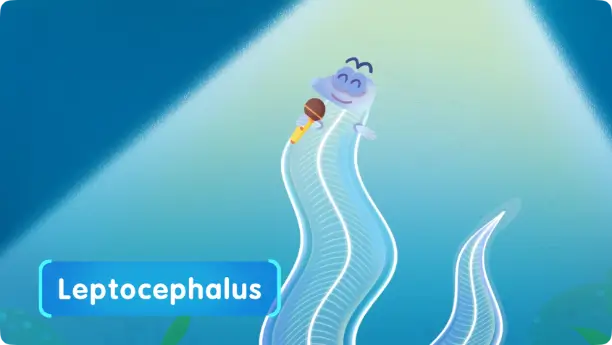
The ocean is home to many unique sea animals with extraordinary physical features. Beroid comb jellies are flat like a disc and emit rainbow lights that look like a spaceship cruising through the water.
Another fascinating creature is the leptocephalus which is a young eel larva with a body as thin as a tree leaf. Its body is completely transparent to help it hide from predators before it eventually grows into a thicker glass eel and then an adult eel.
What is a sea pen?

Survival for unique sea animals often involves clever defense mechanisms. Sea pens are cnidarians that look like feathers and use poisonous needles in their tentacles for protection.
They can scare off predators by glowing and then protect themselves by curling up into a small unit. Flying fish have also developed a special way to escape danger by jumping out of the water. These fish spread their fins to glide in the wind for distances up to 1,300 feet.
What is the largest fish?
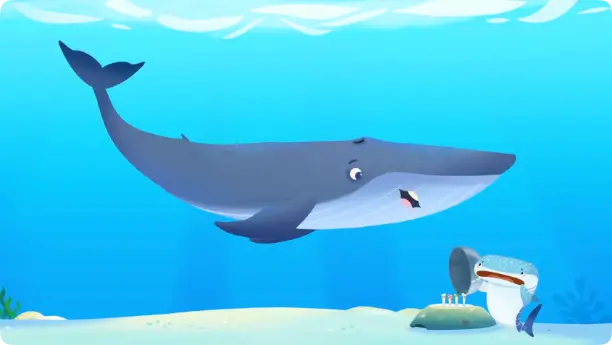
Size is a major factor that defines some of the most unique sea animals on Earth. Whale sharks are the largest fish species and can grow to be almost 60 feet long. They have over 300 rows of tiny teeth and use their gills to filter out seawater after taking massive gulps of food. Even bigger is the blue whale, which is the largest marine mammal and the largest animal to ever exist on Earth. Growing up to 98 feet long, the tongue of a blue whale alone weighs as much as an elephant.
Fun Fact
- Beroid comb jellies look like disc-shaped spaceships with rainbow lights.
- Eel larvae called leptocephali are as thin as leaves and completely see-through.
- Sea pens are made of many small units and have poisonous needles for defense.
- Flying fish can glide through the air for more than four football fields.
Vocabulary
- Leptocephalus: A leaf-thin and transparent eel larva that uses its clear body to remain invisible to predators while drifting in the open ocean.
- Baleens: A set of bushy, comb-like structures found in a blue whale’s mouth that act as a giant filter to trap tiny shrimp-like krill while letting seawater escape.
- Gliding: A survival behavior used by animals like flying fish to escape danger by jumping out of the water and spreading their fins to travel through the air.