
What Are Seagrass Meadows?
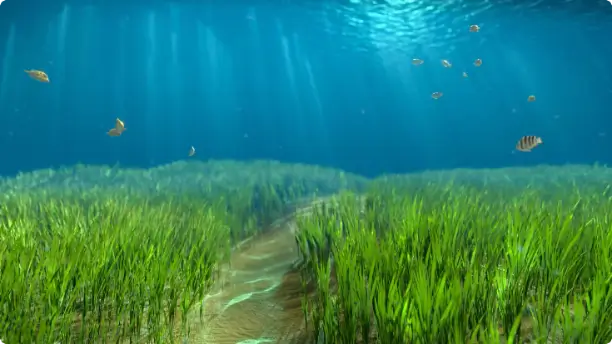
Are you looking for an easy way to teach your child about seagrass meadows? We’ve put together a set of free materials that parents and teachers can use right away.
In this lesson, your child will dive into the fascinating world of seagrass meadows. We’ll explore the unique animals and plants found in lush underwater seagrass fields. Explore science in a more engaging way with captivating 3D videos and interactive quizzes. Download our app to get started!
Table of Contents
What You Will Learn From This Lesson
- Seagrass meadows serve as essential habitats and food sources.
- Marine reptiles demonstrate unique biological traits and breathing methods.
- Specialized marine animals utilize physical adaptations for survival.
What are seagrass meadows?
The seagrass meadows serve as a critical underwater environment where various marine animals find nutrition and shelter. Many unique species rely on this habitat as a primary food source.
For example, the dugong is a marine animal known to consume large amounts of seaweed within these meadows. Green sea turtles also thrive here because the seaweed from the seagrass meadows tastes great to them. These animals act like natural cleaners as they graze across the underwater vegetation.
What sea animals live in seagrass meadows?
Beyond providing food, seagrass meadows are home to animals with incredible camouflage and survival traits. The leafy seadragon is a specialized fish that looks exactly like moving seaweed to hide from others. Its leaflike structures are actually fins, and its gills are located right behind its eyes.
These meadows also support marine reptiles like sea turtles, which have scales and must hold their breath underwater because they breathe through lungs. Some fish, such as surgeonfish, even form friendships with turtles by eating the algae off their shells.
Fun Fact
- Dugongs eat seaweed in the meadows so efficiently they resemble underwater vacuum cleaners.
- Marine reptiles like sea snakes and turtles must use lungs to breathe just like humans.
- Sea turtles are amazing divers that can hold their breath underwater for several hours.
- Green sea turtles aren’t born green, they turn that color because they eat so much “salad” in the form of seagrass and algae.
- The leafy seadragon is a master of disguise that looks exactly like a piece of drifting seaweed to trick its hungry predators.
Vocabulary
Seagrass Meadows: Underwater fields of flowering plants that grow in shallow coastal waters. They provide a safe nursery home and vital food source for many diverse marine animals.
Marine Reptiles: A group of cold-blooded animals with scaly skin that live in the sea but must breathe air through lungs.
Dugong: A large, gentle marine mammal that lives in warm coastal waters and grazes on seagrass.
Leafy Seadragon: A unique fish related to the seahorse with leaf-like skin extensions used for camouflage.