
What is a Kelp Forest?
Are you looking for an easy way to teach your child about the kelp forest? We’ve put together a set of free materials that parents and teachers can use right away.In this lesson, your child will dive into the fascinating world of marine ecosystems.
We’ll explore the towering plants and unique animal relationships within cool underwater forests. Explore science in a more engaging way with captivating 3D videos and interactive quizzes. Download our app to get started!
Table of Contents
What You Will Learn From This Lesson
- Kelp forests provide essential habitats in cool, nutrient-rich waters.
- Interactions between sea otters and urchins maintain forest health.
- Mollusks in the forest demonstrate diverse physical traits and camouflage.
How does the kelp forest grow and function?
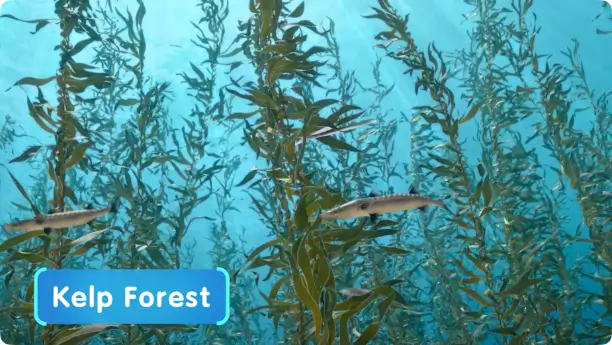
The kelp forest is a towering underwater environment where giant kelps can grow up to 60 meters tall. These massive plants thrive specifically in cool waters that are rich in nutrients. This ecosystem serves as a vital home and provides essential shelter for many different marine animals.
What sea animals live in the kelp forest?
The health of the kelp forest depends on a delicate balance between its residents. Sea urchins are echinoderms that live on the sea floor and use their teeth to eat the roots of the kelp. If sea urchin populations grow too quickly, they can eat up entire forests.
Sea otters play a critical role in protecting the habitat because they eat dozens of sea urchins a day. This relationship keeps the kelp forest healthy by preventing the vegetation from being destroyed.
Many other unique creatures live within the kelp forest as well. Mollusks are common residents that typically have soft bodies and hard shells, such as murex snails and scallops. However, some mollusks like the octopus live here without a shell. The octopus is a master of camouflage that can change its skin color and body shape to look like rocks or other animals.
Fun Fact
- A tiny patch of sea otter skin has as much hair as a human’s entire head to keep them warm.
- Sea otters wrap their tails in kelp like a seatbelt to stop from drifting away while they sleep.
- Sea urchins act like tiny lawnmowers on the ocean floor, constantly crawling around to graze on seaweed in sunny coral reefs and kelp forests.
- Every octopus arm has its own mini-brain, allowing each one to explore and solve problems on its own.
Vocabulary
- Kelp Forest: Underwater forests of giant kelp thriving in cool, nutrient-rich waters. They provide a vertical habitat where diverse marine animals find shelter and food.
- Sea Urchin: A spiny echinoderm that lives on the ocean floor and eats kelp. They move using tiny, water-filled tube feet and have protective needles.
- Sea Otter: A clever marine mammal that protects kelp forests by eating sea urchins. They prevent urchins from overgrazing, keeping the underwater forest healthy and balanced.
- Mollusk: A group of soft-bodied animals like snails, clams, and octopuses. Many grow hard shells for protection, while others use intelligence and skin to survive.
- Camouflage: The ability of an animal, like an octopus, to change its appearance to match its surroundings. This helps them hide from predators or hunt prey.