
What Are Comets?
Are you looking for an easy way to teach your child about space? We’ve put together a set of free materials that parents and teachers can use right away. In this lesson, your child will dive into the fascinating world of comets.
We’ll explore the structure and characteristics of comets and how they form meteor showers. Explore science in a more engaging way with captivating 3D videos and interactive quizzes. Download our app to get started!
Table of Contents
What You Will Learn from This Lesson
- A comet is a Small Solar System Body that orbits the sun.
- A comet has a nucleus, a coma, and a tail.
- Meteor showers happen when Earth crosses a comet’s path.
A comet is classified as a Small Solar System Body. This means that it meets only the first of the three criteria required to be designated as a planet: it orbits the sun. When a comet is in the far reaches of its orbit, it remains in a frozen state. A well-known example is Halley’s Comet, which is visible near Earth approximately once every 76 to 79 years.
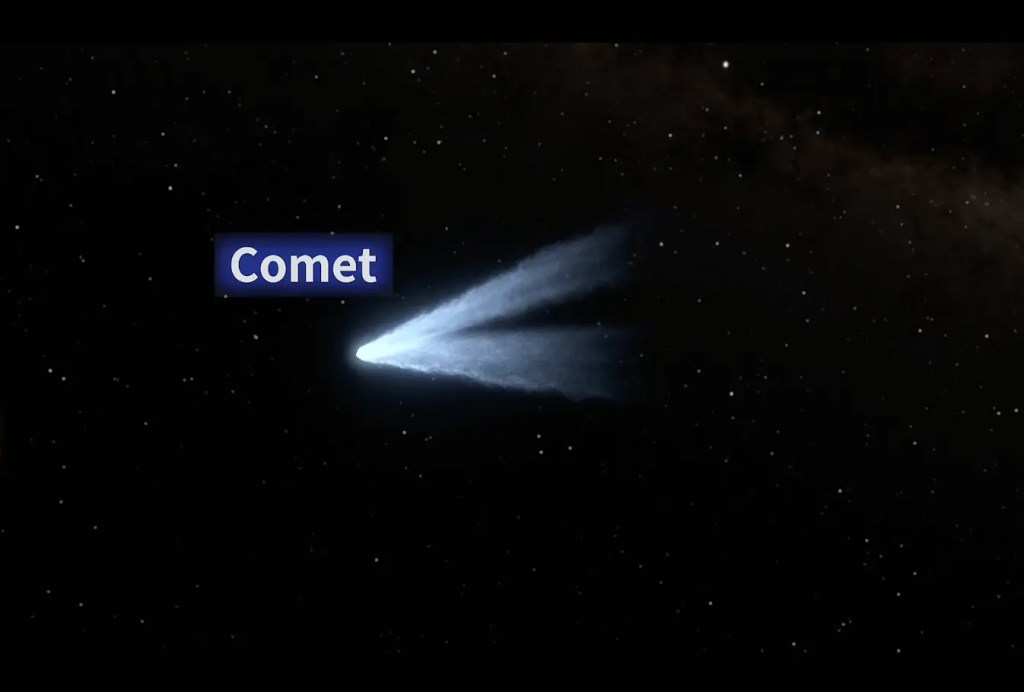
The structure of a comet is divided into three main components: the nucleus, the coma, and the comet tail. The nucleus forms the solid core and is often called a “dirty snowball” due to its loose composition. This core is primarily composed of materials such as ice, methane, ammonia, and carbon dioxide.
A comet’s distinctive tail and coma are formed when it travels closer to the sun. As it approaches the sun, the ice in the nucleus heats up and turns directly into gas, carrying dust with it. This material then stretches out into space, creating the long coma and the striking comet tail. The dust and fragments released by the comet stay behind in its orbital path. When the Earth crosses this path—the comet’s orbit—it encounters this debris. The subsequent entry of these fragments into Earth’s atmosphere results in light friction, which is what observers on Earth see as a meteor shower.
Fun Fact
- A comet’s nucleus is like a “dirty snowball” made of ice, dust, and frozen gases.
- When far from the sun, a comet is frozen and appears dark.
- Halley’s Comet is seen near Earth only once every 76 to 79 years.
Vocabulary
- Comet: A celestial body that orbits the sun and is visible when near the sun, having a nucleus and often a tail of gas and dust.
- Nucleus: The central, solid, and ice-containing part of a comet, often referred to as a “dirty snowball”.
- Coma: The cloud of gas and dust that forms around the nucleus when a comet gets close to the sun.
- Comet Tail: The long streams of gas and dust released by a comet as it moves closer to the sun.
- Meteor Shower: An event where many meteors can be seen as Earth passes through the dust and debris left in a comet’s orbit.