
What Are Nebulae?
Are you looking for an easy way to teach your child about space? We’ve put together a set of free materials that parents and teachers can use right away. In this lesson, your child will dive into the fascinating world of nebulae.
We’ll explore their structure, types, and cosmic role. Explore science in a more engaging way with captivating 3D videos and interactive quizzes. Download our app to get started!
Table of Contents
What You Will Learn from This Lesson
- Nebulae have three main types.
- Some nebulae are birthplaces for new stars.
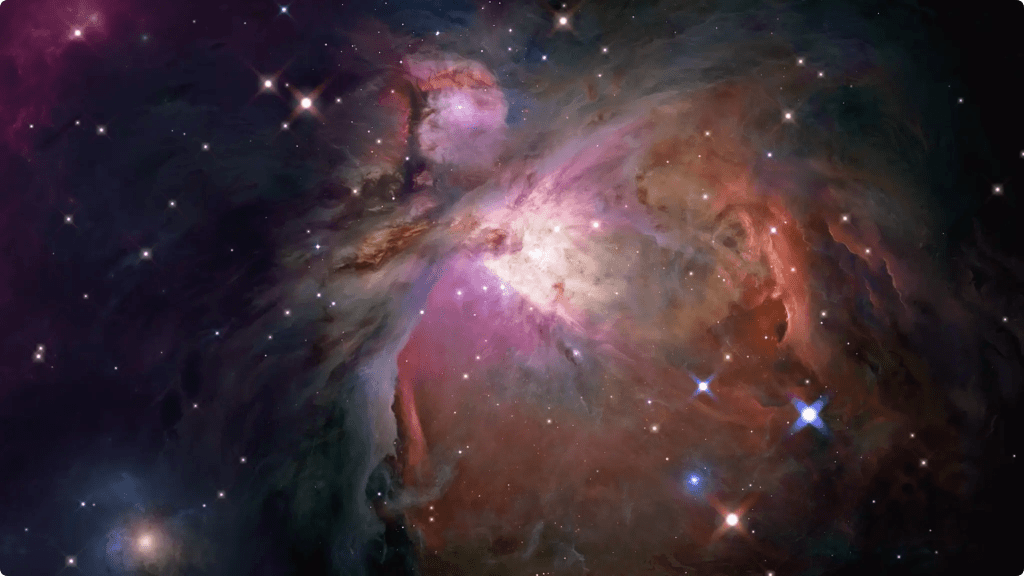
Nebulae are celestial objects that look like huge clouds of gas and dust in the space between stars. They are formed by gas and dust present in the universe.
How Many Types of Nebulae Exist?
Astronomers primarily categorize nebulae into three types: diffuse nebulae, planetary nebulae, and supernova remnants.
- Diffuse Nebulae: This group includes emission nebulae, like the Orion Nebula, which emit a reddish light. It also includes reflection nebulae, which do not produce their own light but reflect the light of nearby stars, often appearing bluish. Lastly, there are dark nebulae, which contain so much dust that they block light from behind, creating a shadowy appearance, such as the Horsehead Nebula.
- Planetary Nebulae: When viewed through a telescope, these nebulae appear similar to a planet, often having a spherical or disk-like shape, leading to their name.
- Supernova Remnants: These are formed when very massive stars reach the end of their lives and explode in a supernova. The material ejected from the explosion forms this type of nebula.
What Do Nebulae Do in Space?
Both planetary nebulae and supernova remnants are created at the end of a star’s life. Paradoxically, some nebulae also serve as the birthplace for new stars, acting as a “cradle of stars.” New stars are constantly forming within these gas and dust clouds, producing light that keeps the universe bright.
Fun Fact
- A supernova remnant is what remains after a massive star explodes.
- Nebulae can be described as the “cradles” where new stars are born.
- The Orion Nebula is a well-known example of an emission nebula that shines with red light.
Vocabulary
- Nebulae: Huge clouds of gas and dust existing in the space between stars. They can be the remnants of dying stars or the birthplace of new ones.
- Diffuse Nebulae: A broad category of nebulae that includes emission nebulae, reflection nebulae, and dark nebulae.
- Planetary Nebulae: Nebulae that form from the final stages of a star’s life and appear spherical or disk-like when observed.
- Supernova Remnants: The expanding clouds of material left behind after a massive star explodes as a supernova.
- Emission Nebulae: Nebulae that generate and emit their own light, often appearing red.
- Reflection Nebulae: Nebulae that do not make their own light. Instead, they shine by reflecting light from nearby stars.
- Dark Nebulae: Nebulae that hold lots of dust. They block light from stars behind them, creating dark, shadowy regions.
- Supernova: A bright and powerful explosion of a star. It signals the end of a massive star’s life.