
What Are the Facts about Earth?
Are you looking for an easy way to teach your child about space? We’ve put together a set of free materials that parents and teachers can use right away. In this lesson, your child will dive into the fascinating world of Earth.
We’ll explore the planet’s location, structure, rotation, and orbit. Explore science in a more engaging way with captivating 3D videos and interactive quizzes. Download our app to get started!
Table of Contents
What You Will Learn From This Lesson
- Earth is the third planet from the Sun.
- Earth has a core, mantle, and crust.
- Earth’s rotation causes day and night.
- Earth’s tilted axis causes the seasons.
Where Is Earth in the Solar System?
The Earth is the third planet from the Sun. It is located approximately 150 million kilometers away from the Sun. This distance is perfect, creating suitable temperatures and allowing for liquid water. Only a small portion of the Earth’s surface is land; the majority is ocean.
What Layers Make Up the Earth?
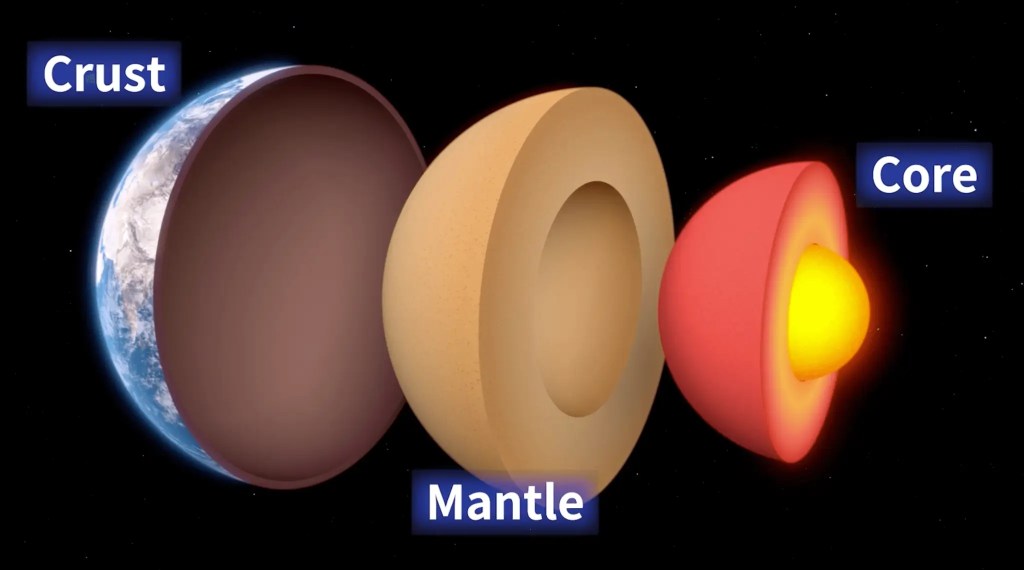
The structure of Earth is composed of three main internal layers: the core, mantle, and crust. The core is the innermost part and is extremely hot, with its hottest part reaching almost as high as the Sun’s surface. Surrounding the core is a thick layer called the mantle.
Above the mantle is a thin layer of rock known as the crust. Beyond the crust is the atmosphere, which is primarily made up of nitrogen and oxygen. The plentiful oxygen allows living creatures to breathe freely. The atmosphere also acts like a protective shield against damage from the universe and helps regulate the planet’s temperature.
What Causes Day and Night?
The cycle of day and night is caused by the rotation of Earth. At any given moment, the Sun can only illuminate one half of Earth. The half receiving light is called the dayside, where it is daytime, and the half in shadow is the nightside, where it is nighttime.
As Earth rotates, different locations move into the light and then the shadow, causing day and night to alternate. Earth completes one full rotation in 24 hours, which is the length of one day.

Why Do We Have Seasons?
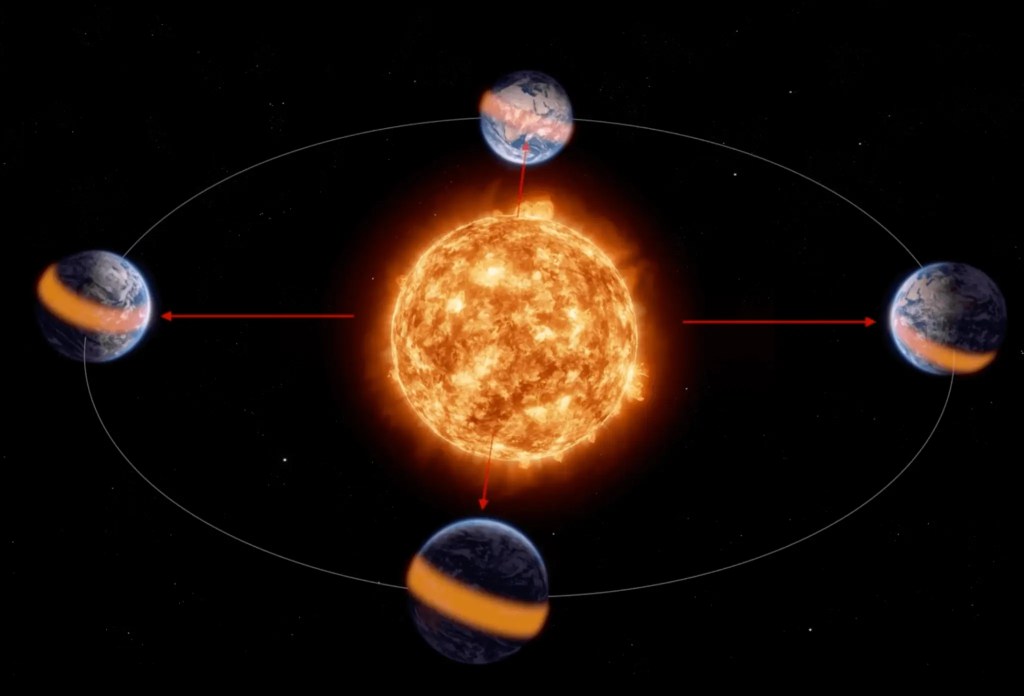
The changing of the seasons is a result of Earth’s revolution around the Sun. It takes Earth one year to complete one orbit. Earth’s axis of rotation is tilted.
Because of this tilt, some places on Earth receive more direct sunlight and heat, while other places receive less. As Earth moves in its orbit, the amount of sunlight received changes, which affects surface temperatures and causes the four seasons: spring, summer, autumn, and winter.
Fun Fact
- The Earth’s surface is mostly covered by ocean, not land.
- The thick atmosphere shields Earth from harm from the universe.
- Earth’s innermost core has a temperature nearly equal to the surface of the Sun.
Vocabulary
- Core: The innermost, very high-temperature part of the Earth.
- Mantle: The thick layer surrounding the core.
- Crust: The thin, rocky outermost layer of the solid Earth, located above the mantle.
- Atmosphere: The layer of air, mainly nitrogen and oxygen, found beyond the crust that protects Earth.
- Rotation: The spinning of Earth on its axis that causes day and night.