
What Are the Facts about Jupiter?
Are you looking for an easy way to teach your child about space? We’ve put together a set of free materials that parents and teachers can use right away. In this lesson, your child will dive into the fascinating world of Jupiter.
We’ll explore the planet’s characteristics as a gas giant. Explore science in a more engaging way with captivating 3D videos and interactive quizzes. Download our app to get started!
Table of Contents
What You Will Learn From This Lesson
- Jupiter is a gas giant of hydrogen and helium.
- Jupiter is the largest planet in our solar system.
- Jupiter’s fast rotation causes it to bulge at the equator.
- Jupiter has many moons.
What Is Jupiter Made Of?
Jupiter is classified as a gas giant, meaning it is primarily composed of light elements like hydrogen and helium. Unlike Earth, this colossal planet does not have a solid, defined surface to stand on. Its massive size and appearance are largely defined by its dense atmosphere.
The vivid colors seen on the planet are a result of chemical elements in the atmosphere interacting to form colorful cloud belts. Within these belts, powerful storms are constantly raging. The most prominent storm is a massive, swirling vortex known as the Great Red Spot. This intense hurricane-like storm has been active on Jupiter for over 300 years.

How Big Is Jupiter?
Jupiter is the largest planet in our solar system. Its diameter is more than 11 times that of Earth. To truly grasp its scale, consider that over 1,300 Earths could fit inside it. The Great Red Spot is a massive storm that is currently about 1.3 times as wide as Earth.

Why Does Jupiter Have a Funny Shape?
The gas giant is known as the fastest rotating planet in the solar system, spinning once in about ten hours. This incredible rotation speed pushes the planet’s material outward. This effect causes it to bulge at the equator, making it slightly flattened at the poles.
How Many Moons Does Jupiter Have?
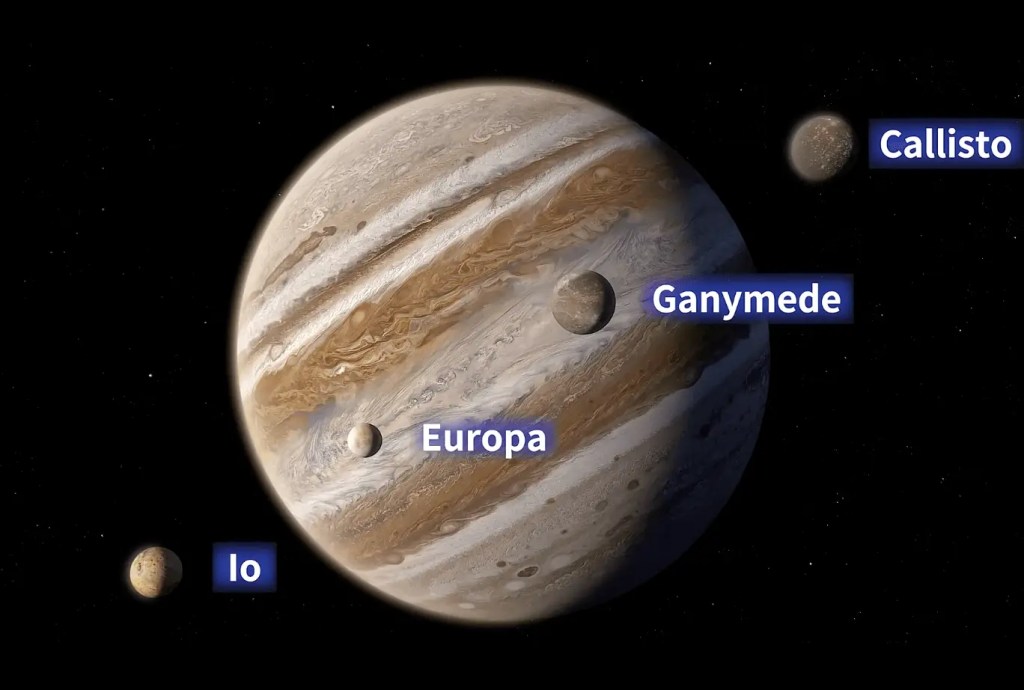
Jupiter has many moons orbiting it. The most famous are the four large satellites called the Galilean moons. These four moons are Io, Europa, Ganymede, and Callisto. They are named after the great astronomer Galileo, who first discovered them with his handmade telescope about 400 years ago.
Fun Fact
- Jupiter is the fastest rotating planet in our entire Solar System.
- The Great Red Spot is a massive, intense storm that is a large vortex.
- The powerful Great Red Spot storm has been active for over three centuries.
Vocabulary
- Gas Giant: A large planet primarily composed of lighter elements, such as hydrogen and helium, that lacks a solid surface.
- Hydrogen: The most abundant element that makes up the composition of the planet Jupiter.
- Helium: A primary element that, along with hydrogen, forms the planet Jupiter.
- Atmosphere: The dense, outermost layer of gas around Jupiter, where cloud belts and powerful storms are found.
- Great Red Spot: An enormous, intense, and long-lasting storm and swirling vortex visible on Jupiter’s surface.
- Galilean Moons: The name given to Jupiter’s four largest moons (Io, Europa, Ganymede, and Callisto), which were discovered by the astronomer Galileo.