
What Are the Facts about Saturn?
Are you looking for an easy way to teach your child about space? We’ve put together a set of free materials that parents and teachers can use right away. In this lesson, your child will dive into the fascinating world of Saturn.
We’ll explore the unique properties, rings, and moons of the planet Saturn. Explore science in a more engaging way with captivating 3D videos and interactive quizzes. Download our app to get started!
Table of Contents
What You Will Learn From This Lesson
- Saturn is a gas giant made of hydrogen and helium.
- Saturn’s rings look bright because they contain ice.
- Saturn has more than 100 moons, including Titan and Enceladus.
What Is Saturn Made Of?
Saturn is the sixth planet from the Sun. It is a gas giant, composed mostly of hydrogen and helium, just like Jupiter. Interestingly, Saturn has the lowest density of all the eight planets. If placed in a large enough body of water, Saturn would actually float. It has even been nicknamed the “Ringed Planet”.

Why Are Saturn’s Rings Bright?
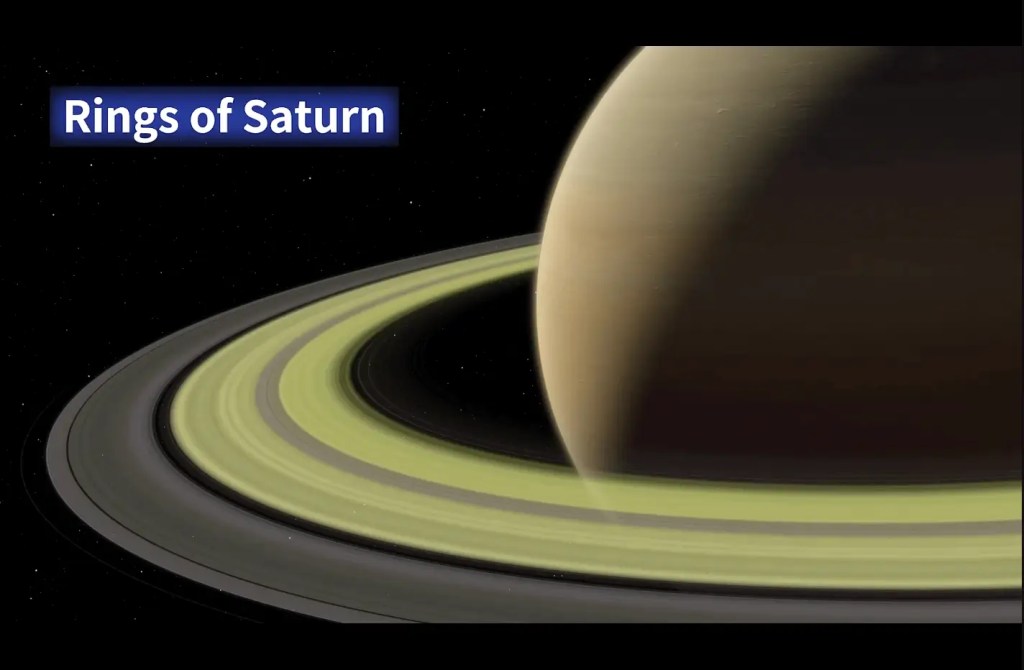
The prominent feature surrounding Saturn is its ring system, known as the Rings of Saturn. There are seven known rings, with gaps between them. These rings look bright because their main components are ice and dust, or rock. This ice effectively reflects sunlight, making the rings appear dazzling and bright.
How Many Moons Does Saturn Have?
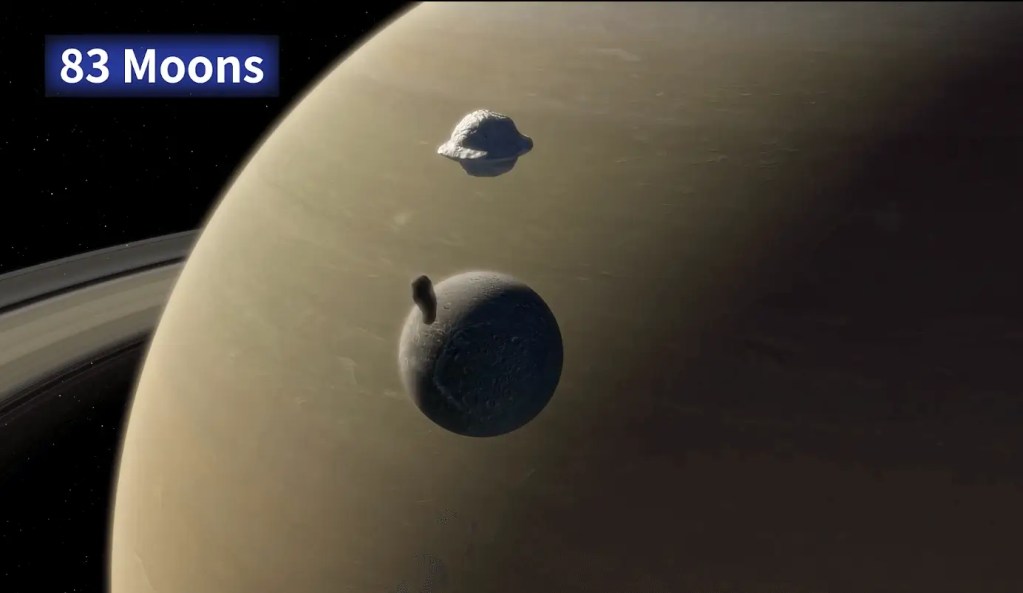
Saturn has a great number of moons. Currently, Saturn is known to have more than 100 moons. These moons vary greatly in size and shape; some are small, while others are large. One of Saturn’s most notable moons is Enceladus, which has active undersea volcanism, causing water to erupt from its icy surface. This water then freezes and contributes to the formation of the Rings of Saturn. Another famous moon is Titan, the only moon in the Solar System with a dense atmosphere.
Fun Fact
- Saturn is the most distant planet from the Sun visible to the naked eye.
- The water plumes erupting from the moon Enceladus freeze and become part of Saturn’s rings.
- Unlike Earth, the rivers, lakes, and oceans on the surface of Titan are filled with liquid methane.
Vocabulary
- Gas Giant: A large planet primarily composed of lighter elements like hydrogen and helium, without a solid surface.
- Rings of Saturn: The beautiful group of seven rings that go around the planet Saturn. They are mostly made of ice and dust.
- Ice: A solid form of water that makes up the main material of Saturn’s rings.