
What Is the Difference between Rotation and Revolution?
Are you looking for an easy way to teach your child about space? We’ve put together a set of free materials that parents and teachers can use right away. In this lesson, your child will dive into the fascinating world of rotation and revolution.
We’ll explore the difference between rotation and revolution. Explore science in a more engaging way with captivating 3D videos and interactive quizzes. Download our app to get started!
Table of Contents
What You Will Learn From This Lesson
- Rotation is a celestial body spinning on its own axis.
- Revolution is a body traveling in an orbit around another body.
In the field of astronomy, two key motions describe the movement of celestial bodies like planets and stars: rotation and revolution. While these terms are sometimes used interchangeably, they represent two distinct actions. The difference is simple: rotation is the movement of a body spinning around its own axis, while revolution describes its movement in an orbit around another celestial body.
What Is Rotation?
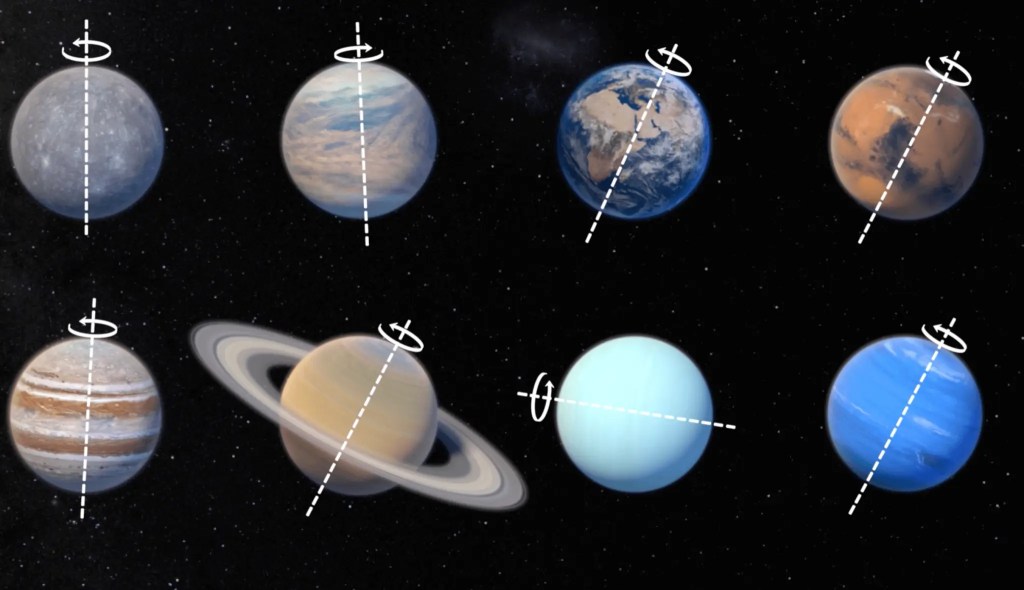
Rotation is the term used to describe a celestial body spinning on its own axis. This movement is also called self-rotation. Planets, like the Earth, spin around an imaginary line called the axis of rotation. The rotation period is the time it takes for a planet to complete one full spin. The rotation period is different for each planet. Earth’s rotation period is one day. Planets in the Solar System mostly rotate counterclockwise, though Venus and Uranus spin in the opposite direction. The planet’s axis may be tilted, causing a unique angle for its rotation. Stars also rotate.
What Is Revolution in Space?
Revolution, also known as orbital motion or planetary revolution, is the movement of a celestial body traveling along a specific path, or orbit, around a central body. Planets revolve around a star. In our Solar System, the eight planets revolve around the Sun, which is a star. The orbital path of the planets is nearly on the same flat plane. A planet’s revolution around its star is in the same direction as the star rotates, which is counterclockwise in the Solar System. The orbital period is the time it takes for a planet to complete one full revolution around the star. Earth’s orbital period is one year.

Fun Fact
- A planet’s rotation period can be as short as 16 hours for Neptune or as long as 59 days for Mercury.
- Some planets, like Neptune, take 165 Earth years to complete a single trip around the Sun.
- The eight planets in our Solar System travel around the Sun in a counterclockwise path.
Vocabulary
- Rotation: When a celestial body spins on its own axis, the movement is called rotation, or self-rotation.
- Revolution: The movement of a celestial body along a set path, or orbit, around another central celestial body is known as revolution.
- Orbit: An orbit is the specific path that a celestial body travels when it revolves around another central body.
- Rotation Period: The amount of time a planet needs to complete one full spin on its own axis.
- Orbital Period: The time it takes a planet to complete one full revolution in its orbit around a star.
- Axis: An imaginary line running through a planet’s poles, which is the center point for its rotation.