
What Is the Sun Composed Of?
Are you looking for an easy way to teach your child about space? We’ve put together a set of free materials that parents and teachers can use right away. In this lesson, your child will dive into the fascinating world of the Sun.
We’ll explore the Sun’s composition and solar activities. Explore science in a more engaging way with captivating 3D videos and interactive quizzes. Download our app to get started!
Table of Contents
What you will learn from this lesson
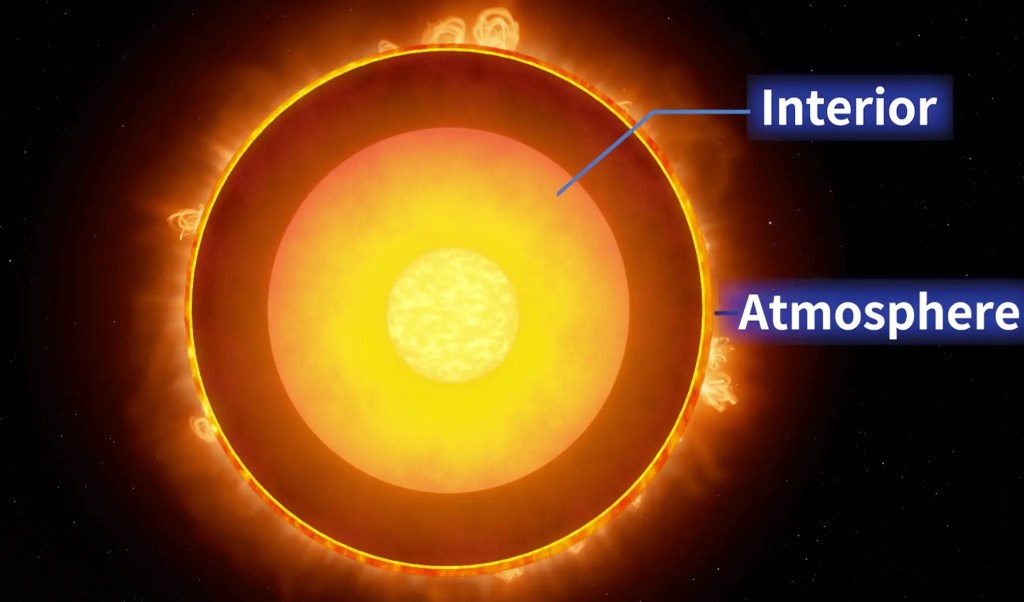
- The Sun has two main parts: the interior and the solar atmosphere.
- Solar activities are changes in the solar atmosphere, like sunspots.
What Are the Sun’s Main Parts?
The Sun is primarily composed of the elements hydrogen and helium. It is constantly creating energy from its core, which is then sent out into space as light and heat. The Sun has two main parts: the interior and the solar atmosphere. All of its energy is produced within the interior.
The interior is made up of three distinct layers. From the inside out, these layers are the core, the radiative zone, and the convection zone. The core is the Sun’s energy source, where temperatures can reach as high as 15 million degrees Celsius. Inside the core, a process called nuclear fusion occurs, where hydrogen is fused to form helium, releasing enormous amounts of energy.
The energy produced in the core passes through the radiative zone and the convection zone before reaching the solar atmosphere. This atmosphere acts like the Sun’s shell and is also made up of three layers, from the inner layer to the outer layer: the photosphere, the chromosphere, and the corona.
The photosphere is the bright, visible surface of the Sun that we can observe on a sunny day. The chromosphere and the corona are less bright than the photosphere. These outer layers can only be seen when the photosphere is blocked, such as during a solar eclipse. The outermost layer of the Sun, the corona, is the part we often draw as the Sun’s “rays.” The Sun is currently in its prime and is expected to continue living for another 5 billion years.
What Are Solar Activities?
The Sun is not only a giant fireball but is also very active. The solar atmosphere is constantly undergoing interesting and sometimes violent changes, which are known as solar activities. These activities are a natural part of the Sun’s life cycle.
One of the most well-known solar activities is the formation of sunspots. These are areas that appear dark in the photosphere because they have lower temperatures than their surroundings. Although they appear black, sunspots are not actually dark.
A solar flare is another type of activity that appears as a sudden burst of intense light in the solar atmosphere. Solar flares usually occur near sunspots and release huge amounts of energy in the blink of an eye.
Another fascinating activity is a solar prominence. This is a gigantic loop made of hot gas that erupts from the chromosphere and extends outwards. A solar prominence can be tens of thousands of kilometers tall, large enough to encircle the Earth!
A powerful solar activity that affects the entire Solar System is called solar wind. This is a constant stream of high-speed, hot, and charged particles flowing from the corona. When the particles of the solar wind reach Earth’s magnetic field, they cause colorful auroras that can be seen in the skies near the North and South Poles.

Fun Fact
- The Sun is so massive that it accounts for 99.86% of the entire Solar System’s mass.
- The Sun’s lifespan is estimated to be another 5 billion years, as it is currently in its prime.
- The Sun’s central core is an energy station, reaching 15 million degrees Celsius (27 million degrees Fahrenheit).
Vocabulary
- Sun: The only star in the Solar System, primarily made of hydrogen and helium, which generates light and heat.
- Interior: The innermost part of the Sun that is responsible for creating and moving energy outward.
- Core: The central and hottest layer of the Sun’s interior where nuclear fusion occurs.
- Radiative Zone: The layer within the Sun’s interior where energy moves outward from the core.
- Convection Zone: The outermost layer of the Sun’s interior, through which energy is transferred.
- Solar Atmosphere: The outer shell of the Sun that includes the layers we see.
- Photosphere: The innermost layer of the solar atmosphere and the visible surface of the Sun.
- Chromosphere: The middle layer of the solar atmosphere, which is less bright than the photosphere.
- Corona: The outermost layer of the solar atmosphere that extends into space.
- Nuclear Fusion: The energy-producing process in the Sun’s core, where hydrogen is converted to helium.