
How Does a Rainbow Form?
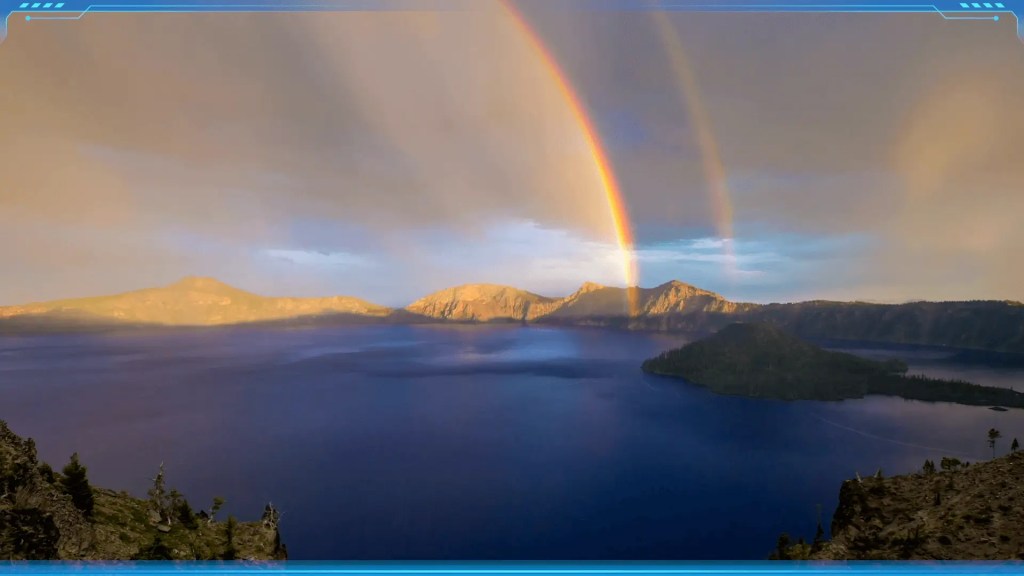
Are you looking for an easy way to teach your child about weather and climate? We’ve put together a set of free materials that parents and teachers can use right away. In this lesson, your child will dive into the fascinating world of rainbows.
We’ll explore the formation and color spectrum of a beautiful sky phenomenon. Explore science in a more engaging way with captivating 3D videos and interactive quizzes. Download our app to get started!
Table of Contents
What You Will Learn From This Lesson
- Sunlight and water droplets make a rainbow.
- See a rainbow with your back to the sun.
What Makes Up a Rainbow?
A rainbow is a beautiful natural light show that requires two main elements: sunlight and tiny water droplets. Sunlight is actually a combination of a full spectrum of colored light. When it shines through the air immediately following rain, countless water droplets are still floating in the sky. These droplets act like small prisms, causing the white sunlight to bend and split into its different colors. The result is a dazzling arc of colors that we see in the sky. The colors appear in a specific sequence: red, orange, yellow, green, blue, indigo, and violet. Sometimes, a secondary, fainter rainbow, called a secondary rainbow, can appear outside the primary arc, with its colors arranged in the reverse order.
Where Can We See a Rainbow?
To spot this colorful phenomenon, you must be in the right location, as the direction of the sunlight entering the droplets is opposite to the direction the colored light exits. This means that to see a rainbow, you must stand with your back to the sun.
Did you know that a rainbow is actually a full circle? Because of the ground, we can only see the top part, which appears as an arc. If you could observe one from an elevated position, such as an airplane, you might be able to see a complete, circular rainbow.
Fun Fact
- A rainbow is not actually an arc; it forms a complete circle, with the rest of it blocked by the ground.
- The primary rainbow can sometimes be accompanied by a fainter secondary rainbow where the order of the colors is reversed.
- A rainbow in the evening can be a sign of clearing skies due to the general movement of weather systems.
- You must turn your back to the sun to see a rainbow in the sky.
- Moonlight can create a faint, nighttime rainbow called a moonbow, which is essentially a rainbow formed by reflected sunlight.
Vocabulary
- Rainbow: A beautiful natural light show that appears in the sky after the rain. It is a dazzling arc of colors formed when sunlight is split by water droplets.
- Sunlight: The energy source that is essential for the formation of a rainbow. It is composed of a full spectrum of colored light, which is split when it passes through water droplets.
- Water droplets: Tiny spheres of water floating in the air, typically following rain. They act like small prisms that cause the white sunlight to bend and split into different colors.
- Secondary rainbow: A fainter rainbow that sometimes appears outside the primary arc. Its colors are arranged in the reverse order compared to the main arc.